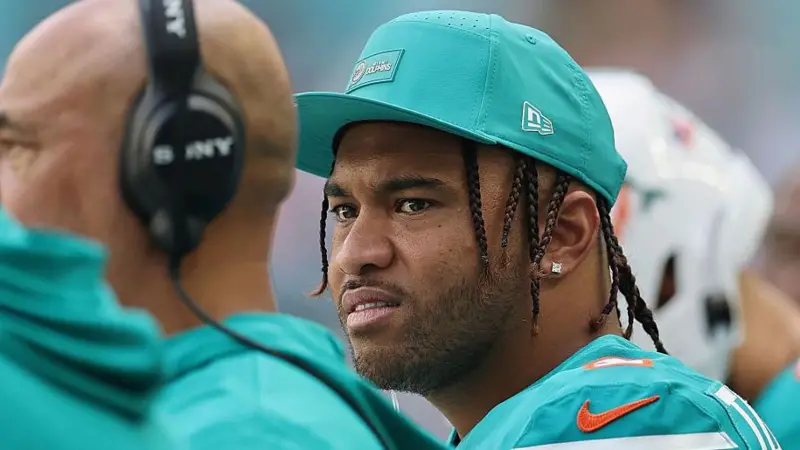
Quinn Ewers started Miami's final three games of last season instead of Tua Tagovailoa
The Miami Dolphins are preparing to part ways with quarterback Tua Tagovailoa, a move that will come with a historic financial consequence. The decision will cost the franchise a staggering $99.2 million (£74.2 million) in dead cap space, the largest such figure ever recorded in the NFL. While the move signals the end of a significant chapter in Miami’s recent history, it also reflects a broader rebuild underway within the organization.
Tagovailoa, now 28, has been the Dolphins’ starting quarterback since being selected fifth overall in the 2020 NFL Draft. During his time in Miami, he experienced both remarkable highs and difficult setbacks. The quarterback showed flashes of elite talent, particularly during the 2023 season when he led the league in passing yards and guided the Dolphins into the playoffs. However, injuries and inconsistent performances in later seasons complicated his long-term future with the team.
Record Dead Cap Cost Marks Historic NFL Decision
The decision to release Tagovailoa will break the previous NFL record for dead cap charges. That record was set in 2024 when the Denver Broncos moved on from Russell Wilson, absorbing $85 million in dead money.
Miami’s situation stems largely from the massive contract extension Tagovailoa signed in 2024. The four-year deal was worth $212.4 million (£158.9 million), signaling the team’s belief that he could remain the cornerstone of the franchise. Yet releasing him only two years into that contract leaves the Dolphins with a financial burden rarely seen in professional football.
General manager Jon-Eric Sullivan confirmed the decision while outlining the team’s broader plans. According to Sullivan, the Dolphins intend to move in a different direction at quarterback once the new league year officially begins.
Injuries and Form Shaped Tagovailoa’s Journey
Although Tagovailoa enjoyed several standout moments in Miami, concerns about his health played a recurring role in his career trajectory. During the 2022 season, he suffered two serious concussions that raised questions about his long-term durability. At one point, the quarterback even admitted he considered retirement because of the risks associated with repeated head injuries.
Despite those concerns, Tagovailoa returned strongly the following season. His league-leading passing yardage in 2023 helped restore confidence among fans and team executives, eventually leading to the lucrative contract extension.
However, the optimism proved short-lived. Just two months after signing the new deal, Tagovailoa suffered another concussion. His performances during the 2025 season were also inconsistent, and he was eventually benched for the final three games as the Dolphins struggled to maintain momentum.
Dolphins Enter Full Rebuild Under New Leadership
The decision to release Tagovailoa comes amid sweeping changes within the Dolphins organization. Earlier this year, the franchise dismissed head coach Mike McDaniel and appointed Jeff Hafley as his successor. At the same time, Jon-Eric Sullivan stepped in as the team’s new general manager, signaling a shift in leadership and long-term strategy.
Since then, Miami has already begun reshaping its roster. Star wide receiver Tyreek Hill was released last month, while safety Minkah Fitzpatrick has been traded to the New York Jets. These moves suggest the Dolphins are committed to building a new core rather than attempting short-term fixes.
Sullivan emphasized that the franchise’s focus is now on creating stronger competition throughout the roster and laying the groundwork for sustainable success in the coming years.
A Wider Trend During NFL Free Agency
Tagovailoa’s departure also reflects a broader pattern during the current NFL free agency period. He becomes the second franchise quarterback to be released this offseason after Kyler Murray.
The Arizona Cardinals recently announced that they would part ways with Murray, the first overall pick in the 2019 draft. His tenure in Arizona included only one winning season, with injuries disrupting much of his seven-year stint.
Together, these high-profile decisions highlight how quickly teams can shift direction in the modern NFL. Even quarterbacks once viewed as franchise cornerstones are no longer guaranteed long-term security.
For the Dolphins, releasing Tua Tagovailoa marks the end of an era defined by promise, setbacks, and moments of brilliance. As Miami moves forward with a fresh leadership team and a reshaped roster, the franchise now faces the challenge of finding its next quarterback while rebuilding toward sustained success.