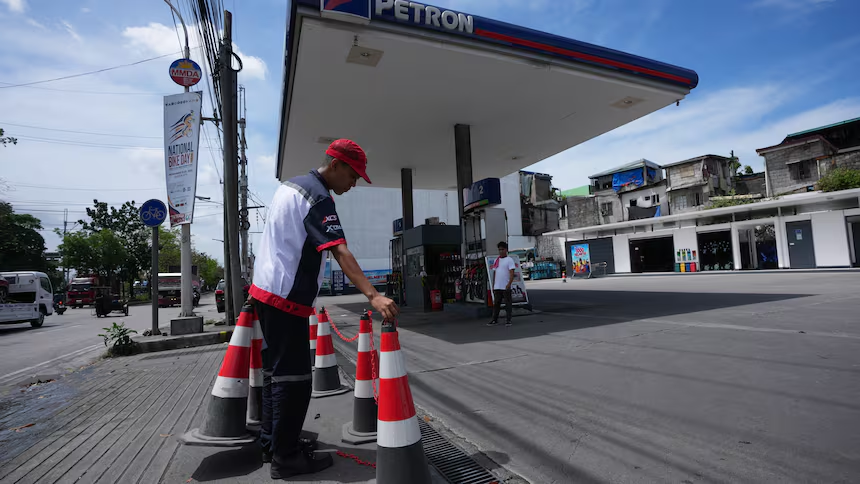
A worker places cones at a gasoline station that closed temporarily when it ran out of fuel while waiting for a new delivery on Monday, in Quezon City, Philippines. Oil prices spiked near $120 US per barrel before falling back on Monday as the conflict in the Middle East intensified.
Global oil markets experienced dramatic swings as the U.S.-Israel war with Iran continued to disrupt critical energy routes and production across the Middle East. Prices briefly surged to their highest level since 2022 before plunging later in the day, highlighting the growing uncertainty gripping global markets.
Brent crude, the international oil benchmark, climbed to $119.50 per barrel early in trading, a level not seen since the months following Russia’s invasion of Ukraine. However, the surge proved short-lived. By late afternoon, prices had tumbled below $90 per barrel, illustrating how rapidly sentiment can shift in an increasingly volatile geopolitical environment.
Despite the drop, oil remains significantly more expensive than before the conflict began on February 28, when crude traded around $70 per barrel.
Strait of Hormuz Disruptions Fuel Market Volatility
Much of the turmoil stems from disruptions near the Strait of Hormuz, a narrow but vital waterway off Iran’s southern coast. Under normal circumstances, roughly one-fifth of the world’s oil supply moves through this strategic passage each day.
However, fears of missile and drone attacks have drastically reduced tanker traffic through the strait. Energy shipments from major Gulf producers — including Saudi Arabia, Kuwait, Iraq, Qatar, Bahrain, and the United Arab Emirates — have slowed significantly as shipping companies weigh security risks.
As exports decline, storage facilities in several producing countries are rapidly filling up. This has forced some regional producers, particularly Iraq, Kuwait, and the UAE, to reduce output temporarily until shipping routes become safer.
At the same time, energy infrastructure has increasingly become part of the conflict. Oil and gas facilities in Iran, Israel, and neighboring countries have been struck during the fighting, raising deeper concerns about long-term supply disruptions.
A Supply Shock Larger Than Past Oil Crises
Energy analysts warn that the current crisis could rival or even exceed previous historical oil shocks.
Nicholas Mulder, a historian studying the economic impact of war, suggested the situation may already represent the largest oil supply shock in modern history. According to his analysis, the number of lost barrels could be three to four times greater than the disruptions experienced during the oil crises of 1973 and 1979.
Over the weekend, the war intensified further. Israeli strikes reportedly hit fuel depots in Tehran, leaving large storage sites burning overnight. Meanwhile, Bahrain accused Iran of targeting a desalination facility essential for its drinking water supply.
The attack also forced Bahrain’s national oil company to declare force majeure, a legal step that allows companies to suspend contractual obligations during extraordinary circumstances.
Governments Watch Closely but Hold Strategic Reserves
As oil prices surged, discussions emerged about releasing emergency crude reserves to stabilize markets. However, the Group of Seven (G7) nations opted not to take that step for now.
Officials said global supplies remain adequate despite the disruption. Still, they emphasized that coordinated action could occur if the situation worsens.
Some analysts believe prices could rise dramatically if the Strait of Hormuz remains blocked for an extended period. Forecasts from several strategists suggest crude could potentially reach $150 per barrel, surpassing the previous record near $147 set before the 2008 financial crisis.
Others expect the disruption to be temporary. Economic researchers from Oxford Economics predict oil could settle around $80 per barrel later in the quarter, although they acknowledge that risks of a prolonged crisis are increasing.
Asian Economies Face Growing Energy Pressure
The surge in oil and gas prices is already rippling through global economies, particularly across Asia. Many countries in the region rely heavily on Middle Eastern imports, making them especially vulnerable to supply disruptions.
Iran alone exports roughly 1.6 million barrels of oil per day, with much of that supply heading to China. If those exports are interrupted, Beijing may need to seek alternative suppliers, potentially pushing prices even higher.
Meanwhile, South Korea has warned energy companies against hoarding or manipulating fuel prices during the crisis. Financial markets across the region have also reacted sharply, with major stock indexes declining as investors digest the economic impact of rising energy costs.
Rising Fuel Costs Could Affect Travel and Consumers
Beyond financial markets, the surge in oil prices may soon affect everyday expenses for consumers.
Higher crude prices typically translate into increased costs for transportation, manufacturing, and agriculture. Airlines are particularly sensitive to fuel costs, and industry leaders are already warning that ticket prices could rise if jet fuel remains expensive.
While many airlines hedge fuel purchases to soften short-term shocks, those protections eventually expire. If high prices persist, the additional costs will likely pass through to travelers.
For now, energy markets remain on edge as the conflict continues. With key shipping routes threatened and infrastructure under attack, analysts say the coming weeks will determine whether the recent volatility becomes a lasting global energy crisis.