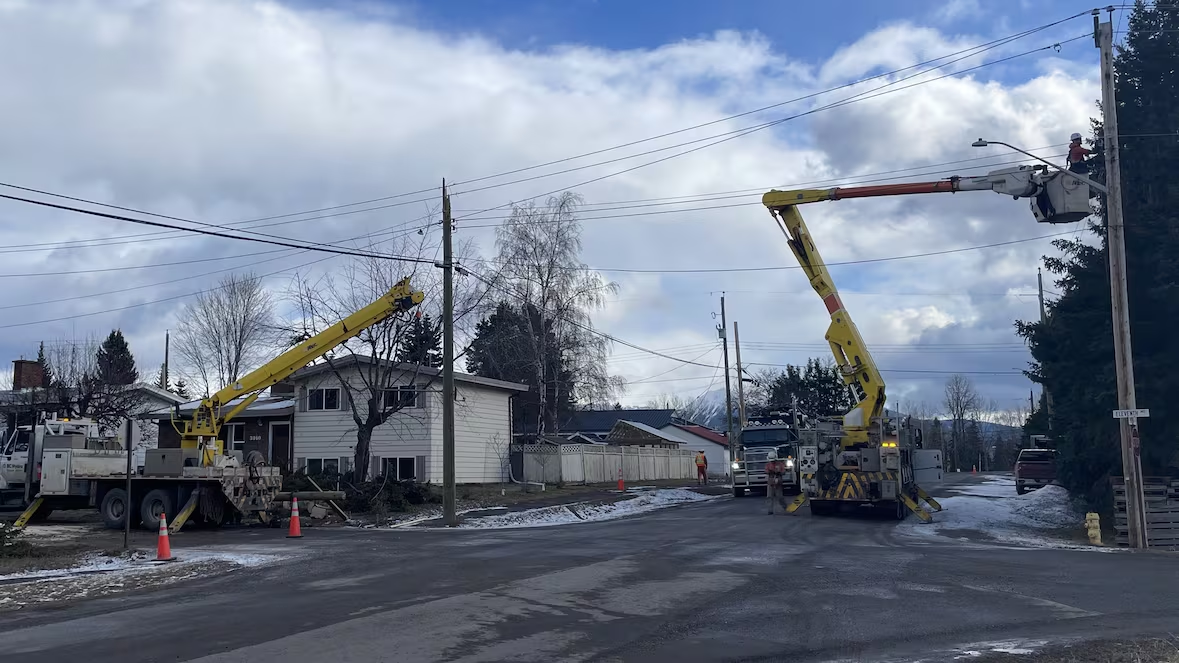
B.C. Hydro repair crews work to restore damaged power lines after a powerful windstorm struck northern British Columbia on March 7. The photo, released on March 9, shows workers repairing equipment following the storm. CBC
A powerful windstorm driven by an unusual cold front caused widespread damage across parts of British Columbia and Alberta over the weekend. Strong winds tore through communities, knocking down trees, damaging buildings, and cutting power to tens of thousands of residents.
Officials reported no injuries, but the storm created significant disruption in several regions. Crews continued repairing damaged equipment on Monday as some households remained without electricity.
Hotel Roof Torn Off in Dawson Creek
One of the most dramatic incidents occurred in Dawson Creek, British Columbia. Strong gusts ripped part of the roof off the Ramada Inn, leaving visible damage to the building.
Across the province, powerful winds also knocked down trees and power lines, creating hazards for drivers and residents.
Damage also appeared across the provincial border in Alberta. In Vermilion, east of Edmonton, high winds damaged a local health centre as gusts reached around 110 kilometres per hour.
Despite the destructive conditions, authorities confirmed that no injuries occurred during the storm.
Power Outages Across Northern B.C.
The storm caused widespread power outages throughout northern British Columbia. At the height of the event, tens of thousands of customers lost electricity.
Utility crews worked throughout the weekend to restore service. Most residents regained power by Sunday, but several hundred homes still lacked electricity by Monday afternoon as crews continued repairs.
Repair teams responded to damaged equipment across multiple communities. Crews replaced broken lines, cleared fallen trees, and restored power infrastructure damaged by the high winds.
Rare Storm Surprises Meteorologists
Weather experts described the storm as unusual.
Brian Proctor, a meteorologist with Environment Canada, said the weather system began on British Columbia’s North Coast before moving east across the province.
"It was a very interesting system," he said.
Proctor explained that the storm followed a path along Highway 16, travelling through Prince Rupert, Prince George, Dawson Creek and Fort St. John. The weather system also moved south into parts of the Kootenay region.
Meteorologists normally expect storms of this type to weaken when they reach the Rocky Mountains. However, this storm maintained its strength as it crossed the region.
Sudden Temperature Drop
The storm also brought sudden changes in temperature.
Near Kelowna, temperatures dropped nearly 12 degrees Celsius within two hours as the cold front moved through the area. At the same time, strong winds knocked down trees and damaged power lines.
These rapid weather changes added to the difficulties faced by power crews trying to restore service.
Damage to Key Power Infrastructure
The storm also affected major electricity infrastructure in northern British Columbia.
Strong winds damaged equipment connected to the W.A.C. Bennett hydroelectric dam, forcing operators to shut down a transmission circuit temporarily.
Officials described the situation as extremely rare.
Even after crews quickly restored the transmission line, workers still needed to repair local distribution lines that supply electricity directly to homes and neighbourhoods.
This additional work slowed the restoration process in several communities.
Bob Gammer from B.C. Hydro said the scale of the damage stood out because the storm affected multiple regions at once.
"This kind of outage is rare," he said.
"We might see this every couple of years but ... when you see almost all of the north impacted, that's unusual."
Crews Continue Restoration Efforts
Repair crews in safety gear continued working in affected areas to restore electricity and clear storm debris.
Officials urged residents to remain cautious around fallen trees and damaged power lines.
Although the storm has now moved through the region, recovery work will continue until the last affected homes regain power.