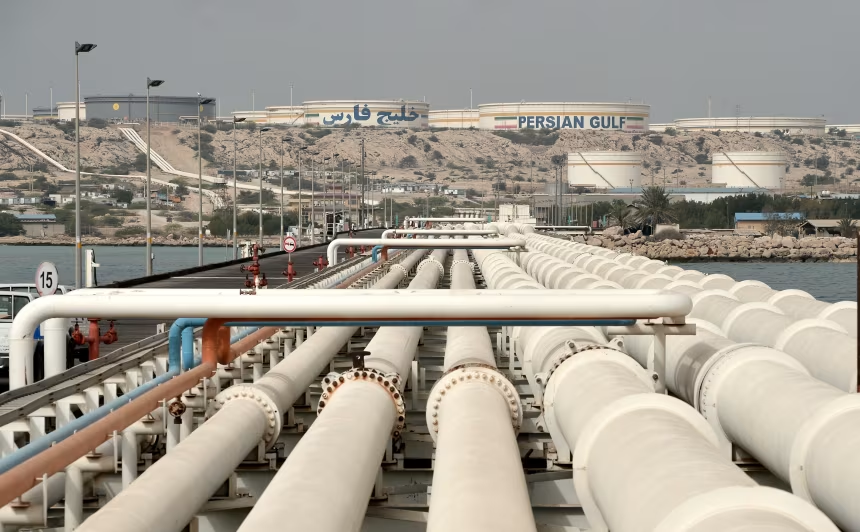
A general view of the Port of Kharg Island Oil Terminal, 25 kilometers from the Iranian coast in the Persian Gulf and 483 kilometers northwest of the Strait of Hormuz, in Iran on March 12, 2017.
As tensions escalated across the Middle East in recent weeks, one location remained notably untouched despite a wave of military strikes across Iran. That place was Kharg Island, a small coral outcrop in the Persian Gulf that quietly handles the majority of Iran’s oil exports.
For nearly two weeks, as U.S. and Israeli strikes targeted Iranian military and energy infrastructure, the island avoided direct hits. Its strategic role in Iran’s economy made it an especially sensitive target, since disrupting its operations could severely impact global oil flows and risk a broader regional escalation.
However, that changed on Friday when the United States launched strikes against military installations on the island. Although the attacks avoided oil infrastructure, the development has brought renewed attention to the critical role Kharg Island plays in both Iran’s economy and the wider global energy market.
Why Kharg Island Is Central to Iran’s Oil Industry
Located roughly 25 kilometers off Iran’s southern coast, Kharg Island may appear insignificant on a map. Yet the island is the backbone of Iran’s crude export system, processing nearly 90 percent of the country’s oil shipments.
Crude oil from major Iranian fields such as Ahvaz, Marun, and Gachsaran travels through pipelines to the island before being loaded onto massive tankers. Its long loading jetties extend into deep waters capable of accommodating some of the world’s largest oil supertankers.
Because of tight security restrictions, the island is sometimes referred to by Iranians as the “Forbidden Island.” Military controls remain strict, reflecting its strategic value to the country.
The facility’s importance has long been recognized internationally. A U.S. intelligence document from 1984 described Kharg’s infrastructure as the most vital component of Iran’s oil system, emphasizing that its continued operation is essential for the country’s economic stability.
Today, Iran produces roughly 3.3 million barrels of crude oil daily, along with about 1.3 million barrels of condensate and other liquids. Much of that output eventually passes through Kharg Island before reaching global markets.
Oil Exports Continued Even During Conflict
Despite growing tensions in the region, oil shipments from Kharg Island have continued at a steady pace. Data from tanker-tracking analysts shows that tankers have been loading crude almost continuously since the outbreak of the latest conflict.
In fact, export volumes had already surged in the weeks leading up to the U.S.-Israeli strikes. Analysts from JPMorgan noted that Iranian shipments approached near-record levels during that period.
The island’s storage infrastructure further supports this export capacity. Kharg is believed to hold about 30 million barrels of oil storage capacity, with roughly 18 million barrels currently stored, according to global trade analysts.
These reserves allow Iran to maintain a steady export flow even during periods of geopolitical uncertainty.
U.S. Strikes Target Military Sites, Not Oil Facilities
The recent U.S. operation marked the first direct strike on Kharg Island during the conflict. According to U.S. officials, the attacks focused exclusively on military targets rather than oil infrastructure.
Video footage shared online showed explosions around the island’s airport and runway facilities. Military officials said additional targets included naval mine storage areas, missile bunkers, and other defense installations.
Iranian media reported more than a dozen explosions on the island but confirmed that oil export facilities were not damaged.
Despite avoiding the oil infrastructure, the strikes significantly raised tensions. Former U.S. officials have warned that targeting the island’s economic facilities could push the conflict into a far more dangerous phase.
Potential Impact on Global Oil Markets
Because Kharg Island is responsible for the majority of Iran’s oil exports, any disruption there could ripple across global energy markets. Analysts say a direct strike on the oil terminal could halt shipments for months while repairs are made.
Rebuilding the facilities would likely be slow and costly, particularly given the sanctions already limiting Iran’s access to international funding and technology.
Major importers could also feel the effects quickly. China, which remains one of the largest buyers of Iranian crude, would likely face the most immediate impact if exports were interrupted.
At the same time, tensions around the Strait of Hormuz, one of the world’s most important oil shipping routes, have already pushed crude prices higher.
Escalation Risks Remain High
Iran has warned that attacks on its oil infrastructure would trigger retaliation against energy facilities elsewhere in the region, particularly those operated by U.S. allies.
In recent weeks, Iranian forces have already targeted oil storage tanks and shipping vessels across parts of the Persian Gulf. Military leaders have also threatened broader strikes against regional energy infrastructure if Iranian export sites come under attack.
Meanwhile, the United States has announced plans to deploy a rapid-response Marine unit to the Middle East. While officials have not confirmed its exact mission, such units are typically used for amphibious operations, evacuations, or rapid military interventions.
For now, Kharg Island remains operational and continues to load tankers bound for global markets. Yet with tensions rising and threats escalating on both sides, the tiny island has become one of the most closely watched locations in the unfolding conflict.