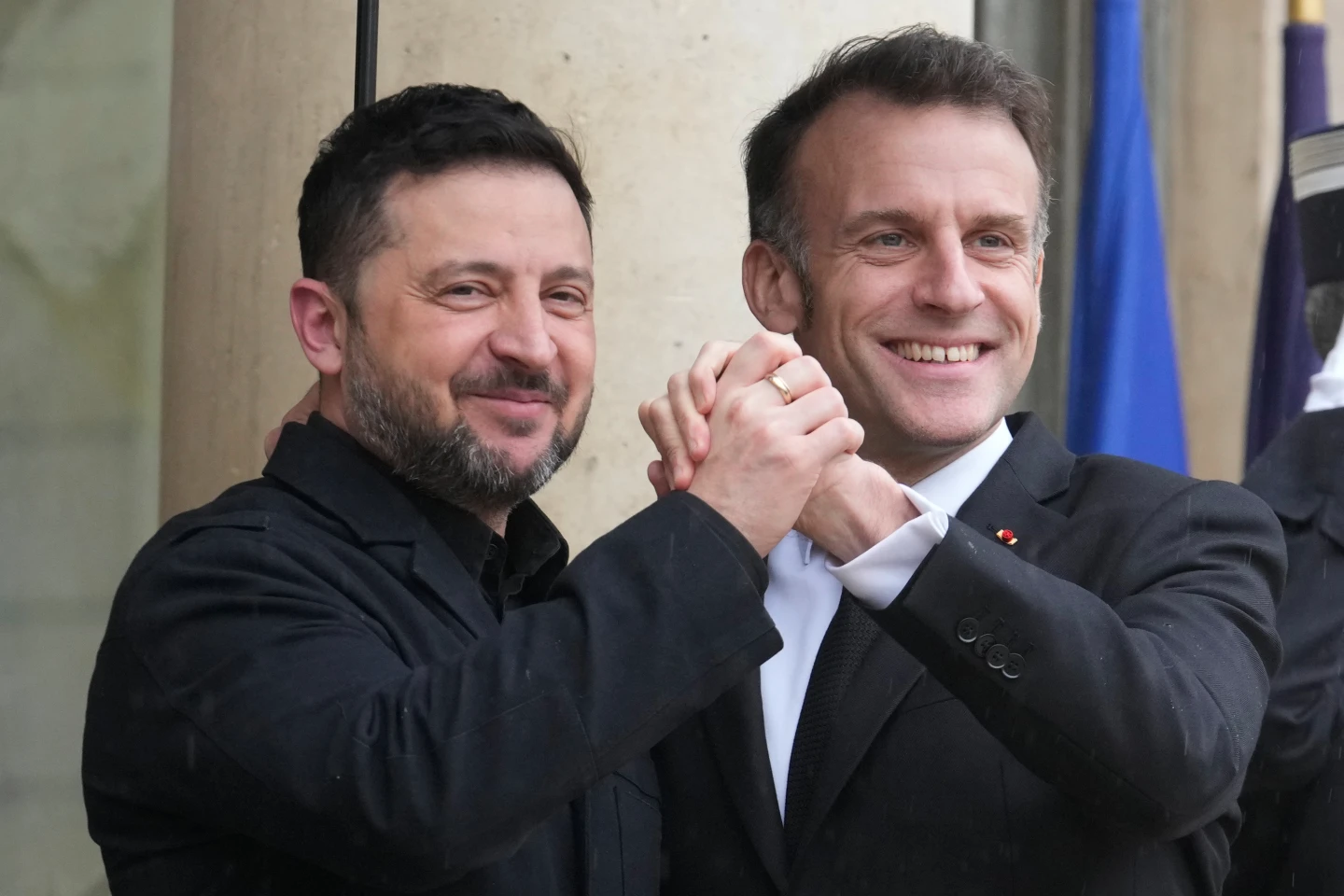
France’s President Emmanuel Macron, right, welcomes Ukrainian Voldymyr Zelenskyy prior to a meeting.
Ukrainian President Volodymyr Zelenskyy has sharply criticized the United States’ decision to grant a 30-day waiver on Russian oil sanctions, arguing that the move could inadvertently strengthen Moscow’s war effort. Speaking during a visit to Paris alongside French President Emmanuel Macron, Zelenskyy warned that easing restrictions on Russia’s energy trade could generate billions of dollars for the Kremlin while the war in Ukraine continues.
The Ukrainian leader said the temporary waiver risks undermining the broader effort to limit Russia’s ability to finance its invasion, which has now stretched beyond four years. While the U.S. described the measure as a short-term response to global supply concerns, Kyiv fears the economic relief could translate into more resources for Russia’s military campaign.
Zelenskyy Warns Waiver Could Fund Russia’s War Effort
Addressing reporters in Paris, Zelenskyy said the decision could have serious consequences for Ukraine’s security. According to him, the easing of sanctions might allow Russia to earn roughly $10 billion in additional revenue, money he believes would ultimately be used to sustain the war.
He argued that lifting restrictions on energy exports only strengthens Moscow’s position. Revenue from oil and gas, Zelenskyy noted, plays a crucial role in funding Russia’s military operations, including drone attacks and weapons production.
From Ukraine’s perspective, the decision sends the wrong message during a critical stage of the conflict. Zelenskyy emphasized that easing sanctions risks enabling more attacks rather than encouraging negotiations or peace efforts.
US Decision Linked to Global Energy Pressures
The U.S. Treasury Department announced the temporary sanctions waiver earlier this week. Officials said the measure aims to release Russian oil shipments currently stranded at sea and stabilize global supplies following disruptions linked to the ongoing conflict involving Iran.
Energy analysts say the war in the Middle East has pushed oil markets into a period of volatility. Blockages affecting production and shipping in the Persian Gulf have driven prices upward, indirectly benefiting Russia’s economy.
Because Moscow remains heavily dependent on energy exports, rising oil prices combined with eased restrictions could improve the country’s financial position. That possibility has heightened concerns among Ukraine and several European allies.
European Leaders Question Washington’s Move
While France adopted a cautious tone, other European leaders voiced stronger criticism of the U.S. decision.
French President Emmanuel Macron noted that the waiver is limited and temporary. He stressed that the broader sanctions regime imposed on Russia remains intact and has not been fundamentally reversed.
German Chancellor Friedrich Merz, however, took a more direct stance. Speaking during a visit to Norway, Merz said most members of the Group of Seven (G7) had expressed concerns about relaxing restrictions on Russian energy.
According to Merz, six G7 countries had indicated to U.S. President Donald Trump that easing sanctions would send the wrong signal. He also questioned the economic rationale behind the move, suggesting that global markets face more of a pricing issue than a true supply shortage.
Ukraine Offers Drone Expertise to International Partners
Even as diplomatic tensions over sanctions continue, Ukraine is trying to expand cooperation with Western and Middle Eastern partners in the field of defense technology.
Over the past two years, Ukraine has become one of the world’s most advanced developers of drone interceptors, systems designed to detect and destroy incoming unmanned aerial vehicles. Kyiv is now offering to share its expertise with the United States and several Gulf countries involved in regional conflicts.
Ukrainian officials hope that such cooperation could lead to access to advanced Western weapon systems that Ukraine cannot manufacture domestically.
However, comments from President Donald Trump suggested Washington may not be interested in Kyiv’s assistance. In a radio interview on Friday, Trump said the United States does not currently need Ukraine’s help in defending against drone threats.
Confusion Over Drone Cooperation Discussions
Despite Trump’s remarks, Zelenskyy indicated that Ukraine had already received requests from Washington related to drone defense cooperation. The reason behind the apparent discrepancy between the two leaders’ statements remains unclear.
Zelenskyy also revealed that six countries have asked Ukraine for help in strengthening their drone defenses. Ukrainian expert teams have already been deployed to three of those nations, although he did not disclose their identities.
He emphasized that Ukraine’s expertise goes beyond manufacturing drone interceptors. Effective defense, he said, requires integrating radars, air-defense networks, and operational coordination across multiple systems.
War Diplomacy Remains on Hold
Meanwhile, diplomatic efforts aimed at ending the conflict between Russia and Ukraine remain uncertain. Zelenskyy said U.S.-mediated talks between Moscow and Kyiv have been paused due to the escalating situation surrounding Iran.
However, he suggested negotiations could resume as early as next week if geopolitical conditions stabilize.
Until then, Ukraine continues to push for stricter sanctions and sustained international pressure on Russia. Zelenskyy reiterated that weakening those measures, even temporarily, risks prolonging the war rather than bringing it closer to an end.