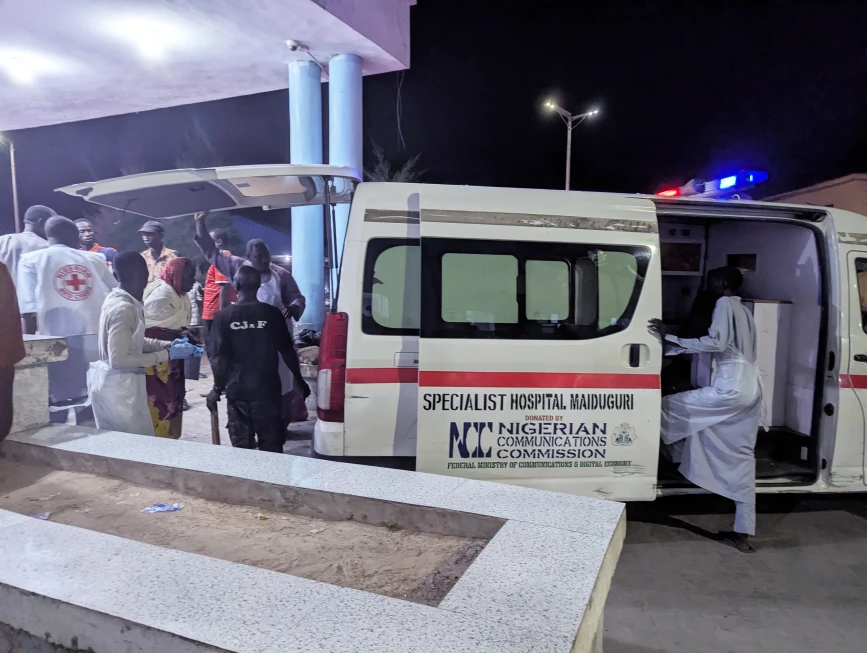
An ambulance is seen at the hospital following a bomb blast in Maiduguri, Nigeria, Monday, March 16, 2026.
A wave of suspected suicide bombings shook Maiduguri in northeastern Nigeria late Monday night, leaving at least 23 people dead and more than 100 others injured. Authorities described the blasts as one of the deadliest attacks in the city in recent years, underscoring the persistent security challenges facing the region.
Residents reported hearing multiple explosions across crowded areas of the city, triggering panic and confusion as emergency responders rushed to assist the injured. Maiduguri, the capital of Borno state, has long been at the center of Nigeria’s battle against militant groups, making the latest attack particularly alarming for both residents and security officials.
Multiple Explosions Rock Crowded Areas
According to local accounts and emergency responders, three explosions struck busy public locations in Maiduguri on Monday evening. One blast reportedly occurred in a bustling market where shoppers and traders had gathered, while another explosion was reported near the entrance of the University of Maiduguri Teaching Hospital.
The explosions sent shockwaves through nearby neighborhoods as first responders and volunteers worked quickly to evacuate victims. Many of the injured were transported to nearby medical facilities for treatment, including the hospital that was itself close to one of the blast sites.
Authorities confirmed that the attacks caused widespread casualties and severe injuries. Borno police spokesperson Nahum Kenneth Daso said in an official statement that 23 people were killed and 108 others suffered varying degrees of injuries in the explosions.
Suspected Suicide Bombings Under Investigation
Police believe the attacks were carried out by suspected suicide bombers, although investigations are still underway to determine the full circumstances surrounding the blasts. Security officials are also working to identify those responsible and prevent further incidents.
So far, no group has formally claimed responsibility for the bombings. However, suspicion has quickly fallen on Boko Haram, the jihadist group that launched a violent insurgency in northeastern Nigeria in 2009.
The group has repeatedly targeted civilians, public spaces, and government institutions in the region as part of its campaign to impose its strict interpretation of Sharia law. Over the years, these attacks have devastated communities and displaced millions of people.
Maiduguri Remains at the Center of Nigeria’s Conflict
Maiduguri has remained a focal point in Nigeria’s long-running fight against extremist groups operating in the northeast. The city serves as a strategic hub for both civilian life and military operations aimed at combating militant activity in Borno state.
Boko Haram has evolved significantly since the insurgency began, splitting into multiple factions and expanding its operational capabilities. One of its most prominent offshoots is the Islamic State West Africa Province (ISWAP), a faction that has pledged allegiance to the Islamic State group and operates across parts of the Lake Chad region.
The continued presence of these militant groups has made the region vulnerable to periodic attacks despite years of military operations aimed at restoring stability.
Renewed Concerns Over Security in the Region
The latest suspected suicide bombings in Maiduguri have reignited concerns about security in northeastern Nigeria. While authorities continue efforts to dismantle militant networks, attacks like these highlight the persistent threat facing communities across the region.
For residents, the explosions serve as a stark reminder that the conflict remains far from over. As investigations continue and victims receive medical care, officials are urging vigilance while reaffirming their commitment to strengthening security in one of Nigeria’s most troubled regions.
In the aftermath of the attack, the focus now shifts to supporting the victims and preventing further violence, as Maiduguri once again confronts the harsh realities of an ongoing insurgency.