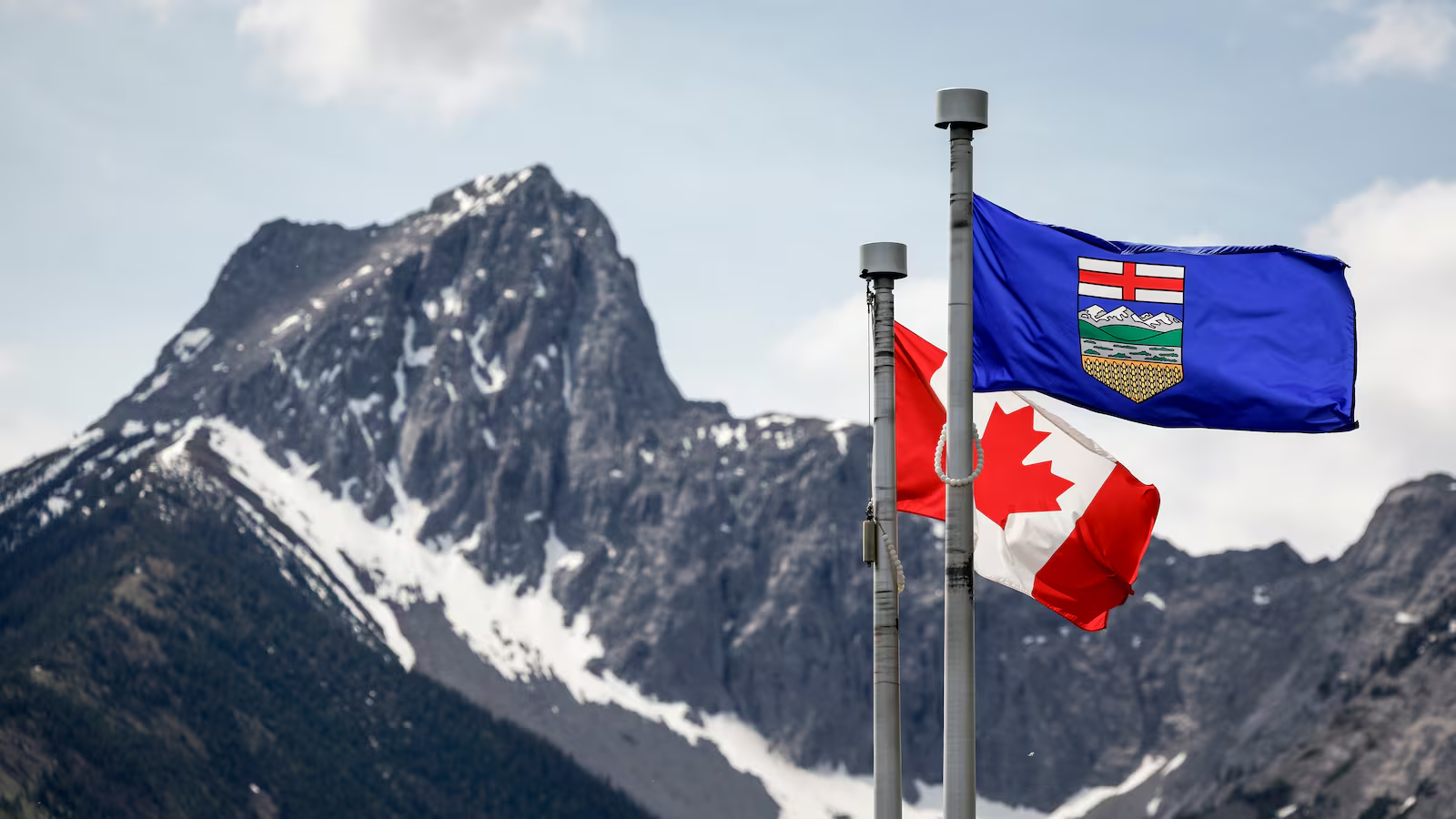
A Canadian flag and an Alberta flag wave in the wind with Wedge Mountain rising in the background at the location of the G7 leaders’ meeting in Kananaskis, Alberta. THE CANADIAN PRESS
Supporters of Alberta’s independence now race against time as they work to collect enough signatures for a citizen-led petition that could trigger a province-wide referendum on whether Alberta should separate from Canada. Organizers have about six weeks left to gather the required number of names.
If the petition succeeds, voters across Alberta would decide the province’s future in a referendum. Yet experts warn that even a successful vote would only mark the beginning of a long and complicated process.
Legal barriers remain
Constitutional experts say Alberta would face many legal and political challenges before it could become an independent country.
Errol Mendes, a professor of constitutional and international law at the University of Ottawa, said the process would not move easily.
“At every single stage, from the time they passed the referendum and somehow managed to get past the two fundamental qualifying issues, at every stage of negotiations, there’s massive barriers to ultimately Alberta becoming an independent state,” Mendes said.
Canada’s Clarity Act sets clear rules for any province that wants to leave the country. The federal law, created after Quebec’s sovereignty referendum in the 1990s, does not allow a province to separate on its own.
If Albertans vote on a clear question and a clear majority supports separation, Ottawa must begin negotiations with the province. Those talks would involve not only the federal government but also other provinces and Indigenous nations, whose treaty rights remain protected under the Constitution.
Concerns from Indigenous leaders
Several First Nations chiefs raised concerns about Alberta’s separatist movement during a meeting with King Charles in London earlier this week. Indigenous leaders continue to stress that any major political change must respect treaty rights and constitutional protections.
Mendes said negotiators would also need to resolve many complicated issues, including pensions.
“There would be huge issues in terms of how you separate out the Alberta pension fund from the Canada Pension fund,” he said.
“That in itself would be a monster discussion.”
He also said leaders would need to deal with questions about national defence and security if Alberta ever moved toward independence.
International recognition another challenge
Even if negotiations produced an agreement, Alberta would still need recognition from other countries before it could fully operate as an independent nation.
“Even if they were successful in terms of any outcome of the negotiation, there’s still an issue which the Supreme Court of Canada mentioned — would it be recognized under international law?” Mendes said.
Jeffrey Rath, general counsel for the independence advocacy group Stay Free Alberta, expressed confidence that the international community might respond quickly.
“The other big wild card out there is that we don’t have any control over when and whether other countries recognize Alberta as being an independent nation,” Rath said.
“Some of that recognition could come immediately after a successful referendum result.”
Rath also dismissed the idea that negotiations would drag on for years.
“Anybody that thinks that this is going to be dragged out for more than a year is crazy. Canada doesn’t want the uncertainty that comes with dragging out these talks, and Alberta doesn’t want the uncertainty of these talks being dragged out,” Rath said.
“There’s a process under which this is all going to roll out, and I think people are going to be shocked by the speed with which this happens.”
Grassroots supporters stay hopeful
For many supporters, the immediate priority remains the petition itself.
At a Calgary bar, Boddums Up Pub co-owner Dwane Fillmore said the independence movement continues to grow.
“They have a hard time listening to Alberta,” Fillmore said of the federal government.
“We’ve been begging and pleading with them for years to listen to us, to listen to the people of Alberta, to support us.”
Fillmore acknowledged that independence would involve several complicated steps after a referendum.
“The referendum is only the first stage,” he said.
“And then going on from there, there’s a lot of hoops you have to jump through.”
Still, he believes the campaign has strong public support.
“I don’t think there will be a problem at all, with the numbers that we have to get the referendum,” he said.