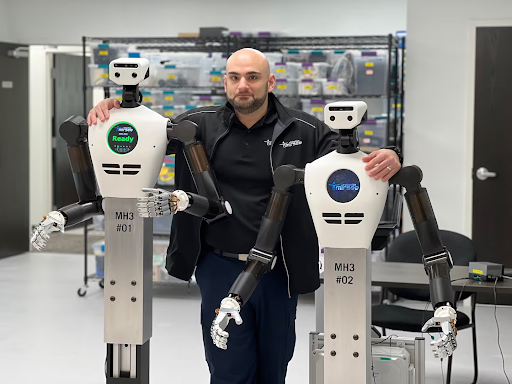
The MH3 humanoid robots from Mirsee Robotics demonstrate AI-powered automation designed for factory and warehouse tasks in the next industrial era.
The race to build smarter, more capable humanoid robots is heating up worldwide, and a small Canadian company believes it is ready to play a major role in what many call the next industrial revolution.
Based in Cambridge, robotics startup Mirsee Robotics is preparing to scale up production of its latest humanoid machine, the MH3. The company’s CEO and co-founder Tarek Rahim says the third generation of the robot is currently undergoing testing, with plans to move toward mass manufacturing as early as next year.
Rahim describes the current moment in robotics as a turning point. Advances in artificial intelligence and machine learning are pushing humanoid robots from experimental prototypes toward real-world industrial tools.
A Global Race in Humanoid Robotics
Recent developments overseas have highlighted just how quickly the industry is evolving.
Last month, a viral video from Chinese robotics firm Unitree Robotics captured global attention. The footage showed humanoid machines performing synchronized kung fu moves, including kicks and flips, with striking precision.
The demonstration signaled a major technological leap from earlier robotic systems and underscored the growing momentum behind humanoid designs.
Rahim says China’s robotics ecosystem has expanded rapidly, with dozens of companies now building human-like machines. In his view, many of those firms currently hold a technological edge over Western competitors.
Humanoid robots from China’s Unitree perform synchronized kung fu routines in a viral video that stunned viewers worldwide.
A Different Approach to Humanoid Design
While many humanoid robots focus on walking with two legs, Mirsee Robotics has taken a different route.
The company’s MH3 robot moves on wheels instead of legs. According to Rahim, the choice was intentional. Wheels provide greater stability, improve battery efficiency, and reduce the risk of the machine tipping over in busy work environments.
During a recent demonstration, the robot used its vision system — developed and built in Canada — to identify a water bottle sitting on a table, pick it up, and relocate it.
Though the task may seem simple, Rahim says it represents a significant technical challenge. Successfully combining vision, movement, and object handling requires advanced coordination between hardware and artificial intelligence.
Designed for Factories and Warehouses
Mirsee’s humanoid robots are designed primarily for industrial environments rather than homes.
The MH3 is built to operate in factories, manufacturing plants, and logistics centres. It can sort items, move materials, and handle repetitive physical work that often leads to high employee turnover.
Rahim notes that many of these tasks are physically demanding yet relatively low-paying. Robots could help fill labour gaps while reducing operational costs for companies.
At the moment, Mirsee Robotics has two working MH3 units. The company expects to build six more robots by the end of the year as it continues refining the design.
Large-scale commercial deployment, however, is still on the horizon. Rahim says that is typical for an industry where both hardware and software are still evolving rapidly.
Robots Enter the Assembly Line
Signs of change are already appearing in Canada’s manufacturing sector.
Toyota Canada recently announced plans to introduce humanoid robots known as Digit at its assembly plant in Woodstock. The machines are produced by U.S.-based Agility Robotics and are designed to assist with logistics and factory tasks.
Such developments reflect growing confidence among manufacturers that humanoid machines could soon become common workplace tools.
From Skepticism to Momentum
The industry has come a long way in a relatively short time.
When Rahim and co-founder Robert Ings first began developing humanoid robots in 2017, interest in the field was limited. At the time, many people doubted that artificial intelligence would evolve quickly enough to support truly capable machines.
That perception has changed dramatically.
Today, rapid advances in AI — including systems similar to ChatGPT — are opening the possibility of robots that can interpret instructions, make decisions, and interact naturally with humans.
Mirsee’s engineering team is now working to integrate voice interaction into the MH3, allowing the robot to respond to spoken commands.
The MH3 humanoid robot is aimed at use in a warehouse or factory. (CTV News)
Looking Toward a Robotic Future
While some companies are experimenting with humanoid robots for household use, Rahim believes consumer versions remain years away from widespread adoption. Cost, complexity, and safety considerations still present major obstacles.
Industrial robots, however, could arrive much sooner.
Mirsee Robotics plans to double its workforce to about 20 employees within the next six months as demand grows and development accelerates.
Rahim believes the transformation underway could rival the scale of the early automotive revolution. In the decades ahead, he expects robots to become as common in factories and warehouses as vehicles once became on city streets.
In fact, he predicts that one day the world may contain more working robots than cars — a sign of how deeply automation could reshape the global economy.