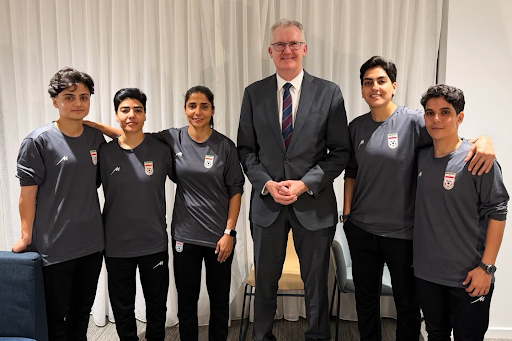
Five Iranian players receive protection under the Iranian team asylum decision as Australian authorities escort them to finalize visas in Brisbane.
Australia has granted asylum to five members of the Iranian women’s soccer team after the athletes requested protection while visiting the country for an international tournament. The decision came as tensions escalated following the outbreak of war in Iran, leaving the players uncertain about returning home.
The Iranian squad had traveled to Australia last month to compete in the Women’s Asian Cup, arriving before the conflict began on February 28. As the situation in their homeland deteriorated, discussions about their safety intensified, drawing widespread attention across Australia and beyond.
Asylum Requests Finalized in Australia
Early Tuesday morning, Australian federal police escorted five players from their hotel on the Gold Coast to a secure location. There, the athletes met with Home Affairs Minister Tony Burke, who finalized the processing of their humanitarian visas later that day in Brisbane.
Burke described the moment as emotional, acknowledging the difficulty of such a life-changing decision. According to the minister, the players expressed both relief and excitement as they signed the documents that would allow them to begin a new chapter in Australia.
He shared that the women were comfortable with their names and photographs being made public and appeared optimistic about their future. While celebrating their new opportunity, Burke also emphasized that the choice to seek asylum was deeply personal and likely difficult for each player.
Uncertainty for Remaining Team Members
Although five players have secured protection, the future of the remaining squad members remains unclear. The official roster included 26 players along with coaches and support staff, and the Australian government confirmed that the offer of asylum had been extended to the entire group.
The Iranian team was eliminated from the Women’s Asian Cup over the weekend, leaving them to decide whether to stay in Australia or return to a country now facing military conflict. Head coach Marziyeh Jafari had earlier indicated that the team hoped to return to Iran as soon as possible.
However, the unfolding situation has complicated those plans, and Australian officials said the players are free to speak with authorities if they wish to explore asylum options.
Public Support and Protest Outside Team Hotel
As the situation developed, scenes outside the team’s hotel on the Gold Coast reflected strong public emotions. A white bus believed to be carrying other members of the squad briefly delayed its departure when protesters gathered nearby.
Some supporters knelt or lay in front of the vehicle, attempting to prevent it from leaving. Others waved pre-Revolution Iranian flags or wore red, white, and green clothing while chanting slogans such as “Save our girls” and “Please act now.”
Despite the demonstrations, the bus eventually departed after a short delay. Authorities did not immediately confirm who was on board or where the vehicle was heading.
Growing Attention Around the Iranian Women’s Soccer Team
Throughout the tournament, the Iranian women’s soccer team had attracted national attention in Australia. During their opening match against South Korea, the players remained silent while the Iranian national anthem played, prompting speculation about whether the gesture signaled protest or mourning.
The team later sang the anthem before their remaining matches, but they largely avoided public comment on the political situation. One player, forward Sara Didar, became emotional during a press conference while speaking about concerns for her family and fellow Iranians.
Australian Prime Minister Anthony Albanese said many Australians had been moved by the athletes’ circumstances. He assured that the country had made support options clear while also respecting the players’ need to make decisions safely, particularly with family members still in Iran.
International Pressure and Diplomatic Conversations
The asylum decision came shortly after U.S. President Donald Trump publicly urged Australia to provide protection for the team. Trump had criticized the Australian government on social media earlier in the week, warning that returning the athletes to Iran could endanger their lives.
In a later message, he praised the Australian government after learning that some players had already received asylum. Albanese confirmed that he had spoken with Trump in what he described as a positive conversation about the issue.
The Australian leader noted that officials had been quietly working for several days to assist the players while ensuring their safety and privacy.
A New Beginning for Some Players
For the five members of the Iranian women’s soccer team who have now received asylum, Australia offers the promise of safety and stability during an uncertain time.
While the fate of the rest of the squad remains unresolved, the decision marks a significant moment in the intersection of sport, politics, and humanitarian protection. As discussions continue, the story of the Iranian women’s soccer team has become a powerful reminder of how global conflicts can unexpectedly reshape the lives of athletes far from home.