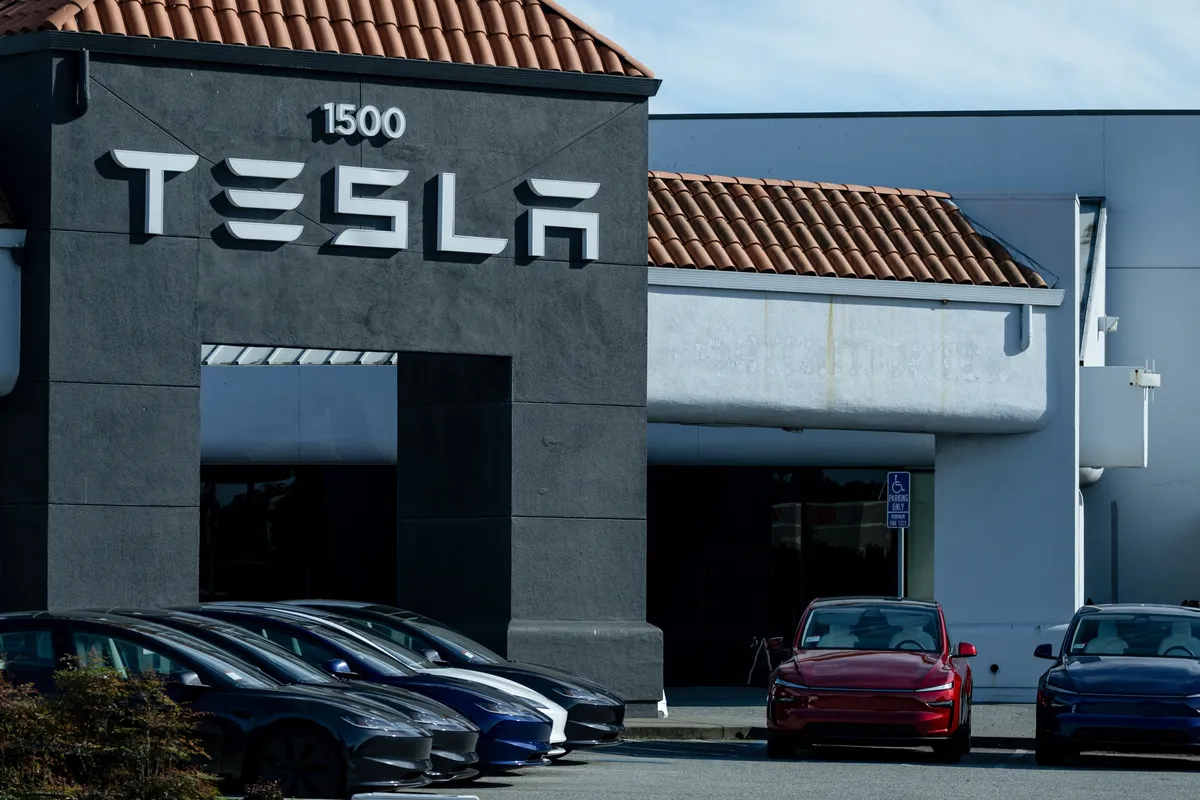
A Tesla store in Colma, California.
In a move that further tightens the links within Elon Musk’s growing business empire, Tesla has converted part of its investment in artificial intelligence startup xAI into a stake in SpaceX. The development comes as the rocket company prepares for a highly anticipated initial public offering that could become one of the largest in history.
Recent regulatory filings show that Tesla obtained approval from U.S. authorities to acquire a small ownership position in SpaceX. The deal effectively transforms Tesla’s earlier investment in xAI into equity in the aerospace company, highlighting how Musk’s various ventures continue to intersect financially and strategically.
Regulatory Filings Reveal New Ownership Structure
Documents submitted to the U.S. Federal Trade Commission on March 11 list Tesla as the acquirer of a SpaceX stake directly from Elon Musk, who serves as chief executive officer of both companies. The filings indicate that Musk has also transferred portions of his holdings to several investors, including Valor Equity Partners and DFJ Growth.
Although such filings are mandatory for transactions exceeding $133.9 million, the exact size of the ownership stakes was not disclosed. Representatives for Tesla, SpaceX, the investors involved, and the Federal Trade Commission did not immediately respond to requests for clarification.
Still, the filings offer a rare glimpse into the evolving ownership structure of Musk’s companies as they prepare for major corporate milestones.
From xAI Investment to SpaceX Equity
People familiar with the transaction say Tesla’s new SpaceX stake originates from its previously announced $2 billion investment in xAI. That investment was made shortly before the artificial intelligence startup merged with SpaceX in a strategic move aimed at combining advanced AI capabilities with space technology development.
Following the merger, Tesla’s financial contribution to xAI was effectively rolled over into the newly integrated structure. As a result, Tesla now holds a small ownership interest in SpaceX rather than a direct position in the AI company.
Sources suggest the converted investment represents less than one percent of SpaceX, though the precise figure remains undisclosed. Even so, the transaction reflects the increasingly interconnected financial relationships across Musk’s portfolio of companies.
Preparing for a Potentially Historic SpaceX IPO
The restructuring arrives at a critical moment as SpaceX moves closer to a public offering expected later this year. Analysts have suggested the listing could become one of the largest IPOs ever, given the company’s dominant position in commercial space launches and satellite deployment.
By aligning ownership stakes and investments ahead of the offering, Musk appears to be consolidating and streamlining the structure of his businesses. Tesla’s participation as a shareholder may also signal confidence in SpaceX’s long-term growth prospects.
At the same time, the move demonstrates how Musk’s ventures frequently overlap, blending resources, funding, and technology across industries that range from electric vehicles and rockets to artificial intelligence and social media.
Musk’s Expanding Web of Interconnected Companies
The conversion of Tesla’s xAI investment into SpaceX equity is only the latest example of Musk integrating his companies more closely.
In 2022, Musk acquired the social media platform Twitter and later rebranded it as X. The platform was subsequently merged with xAI in a deal valued at $33 billion, creating a broader ecosystem focused on AI development and digital platforms.
That merger helped pave the way for the more recent alignment between xAI and SpaceX. When the combined entity was announced earlier this year, it carried an estimated valuation of $1.25 trillion, underscoring the massive scale of Musk’s interconnected business network.
Strategic Positioning Ahead of Major Moves
Reports earlier this year suggested that SpaceX had even explored the possibility of merging with Tesla before ultimately moving forward with the xAI combination. While that idea did not materialize, it illustrates the extent to which Musk’s companies continue to evaluate structural changes aimed at strengthening their strategic positions.
For now, Tesla’s new stake in SpaceX signals another step in that ongoing evolution. As the space company edges closer to its public debut, Musk appears to be carefully aligning his businesses to support the next phase of growth across his technology empire.