South Korean lawmakers approve a law to manage $350B in U.S. investments, aiming to ease trade tensions and protect economic stability.
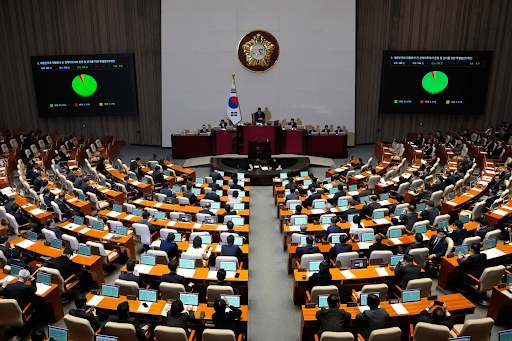
South Korean lawmakers have approved new legislation designed to manage the country’s commitment to $350 billion in U.S. investments, a pledge made last year to ease trade tensions with Washington. The bill, passed on Thursday with overwhelming support, aims to create a structured system for directing the massive investment package while safeguarding South Korea’s economic stability.
The legislation arrives at a time when global trade uncertainty continues to weigh heavily on South Korea’s export-driven economy. Policymakers in Seoul have faced growing pressure to finalize the plan quickly as geopolitical tensions and shifting U.S. trade policies add to market anxiety.
A Strategic Move to Ease Tariff Pressures
The $350 billion in U.S. investments pledge emerged after negotiations between U.S. President Donald Trump and South Korean President Lee Jae Myung during a summit last October. At the time, the agreement was seen as a breakthrough that could prevent South Korean exports from facing the harshest American tariffs.
To implement the commitment effectively, the newly passed law establishes a public corporation tasked with managing and overseeing the investment process. The organization will review potential projects, coordinate with both South Korean and U.S. trade authorities, and determine where the funds should be allocated.
Government officials argued that the structure is essential to ensure transparency and efficiency. By centralizing decision-making, Seoul hopes to channel investments into projects that strengthen economic ties while minimizing financial risk.
Balancing Investments With Economic Stability
While the headline figure of $350 billion in U.S. investments appears enormous, the law includes safeguards designed to protect South Korea’s financial position. Under the new framework, annual investments will be capped at $20 billion per year.
Officials say the cap is intended to prevent excessive strain on the country’s foreign currency reserves. It also allows the government to distribute investments gradually, giving policymakers flexibility to adjust if economic conditions shift.
This cautious approach reflects broader concerns within Seoul about global volatility. South Korea’s economy relies heavily on international trade, making it particularly vulnerable to disruptions caused by protectionist policies or geopolitical conflicts.
Political Debate Delays Approval
Although the government introduced the bill in November, the proposal faced months of resistance in parliament. Opposition lawmakers raised concerns that committing such a large investment sum could expose South Korea to economic risks, particularly if global demand weakens.
Despite the debate, the legislation ultimately passed with a decisive 226–8 vote, signaling broad consensus that the investment framework was necessary under current circumstances.
The political stalemate had already drawn attention from Washington. Earlier this year, President Trump expressed frustration over the delay and warned that the United States could restore tariffs of up to 25% on South Korean goods, including automobiles and pharmaceuticals.
Rising Trade Tensions Add Urgency
The law’s approval comes amid renewed pressure from the United States on its trading partners. On the same day the bill passed, the Trump administration launched a new investigation into overseas manufacturing practices, targeting several countries including China, Japan, and South Korea.
If U.S. officials determine that certain practices disadvantage American industries, the investigation could lead to additional import taxes. The move highlights Washington’s ongoing effort to reshape global trade policies and protect domestic manufacturing.
For South Korea, securing a clear framework for its $350 billion in U.S. investments may help maintain stability in its economic relationship with the United States.
Looking Ahead
With the legislation now in place, South Korea will begin setting up the new corporation responsible for coordinating investment projects. The initiative is expected to deepen economic cooperation between the two countries while giving Seoul more control over how the funds are deployed.
As trade tensions continue to evolve, the success of the $350 billion investment strategy could play a critical role in shaping the future of U.S.–South Korea economic ties.