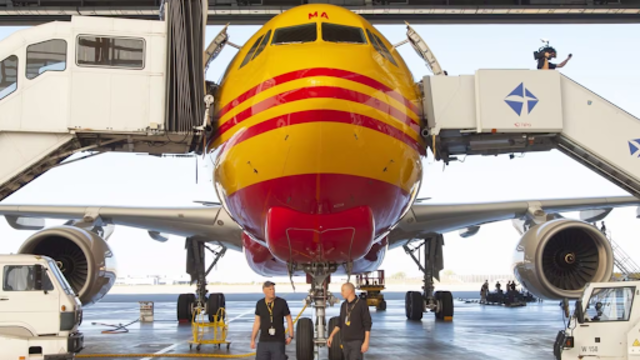
During a launch event on Friday, Oct. 12, 2018, European Air Transport Leipzig GmbH unveiled its new Airbus A330-200 cargo plane, with a DHL Express aircraft on display inside the hangar. (AP Photo)
Postal authorities from countries including France, Germany, Britain, Italy, India, Japan, and Australia announced they would stop accepting U.S.-bound parcels. Other nations soon followed, bringing the total number of affected countries to 25.
The UPU said it expects the suspensions to continue until the U.S. provides clear guidance on how the new system will work.
Impact of U.S. Measures
The U.S. plan requires postal carriers delivering packages into the country to collect customs duties in advance from senders. Those duties must then be passed on to U.S. Customs and Border Protection.
India’s communications ministry explained that only “qualified parties” approved by U.S. authorities can handle this process. But so far, important details about how such parties will be chosen and how duties will be collected remain unclear.
Higher Tariffs and More Checks
Under the new rules, gifts valued up to $100 can still be sent duty-free. However, parcels worth more than that will face new tariffs. For example, shipments from the European Union will carry a 15 percent tariff, while parcels from India will face rates as high as 50 percent.
Germany’s DHL warned customers last week that even duty-free shipments could face extra checks. The company said U.S. customs officers want to ensure commercial goods do not get sent under personal exemptions.
Growing Concerns Worldwide
The UPU, which represents 192 member states, said these changes create “considerable operational challenges” for postal services everywhere. The organization’s director general, Masahiko Metoki, sent a letter to U.S. Secretary of State Marco Rubio to raise concerns about the rushed timeline.
The UPU also noted that the rules could seriously impact cross-border e-commerce. Many online retailers rely on affordable small-parcel shipping to reach U.S. customers, and delays or cost increases may cause lasting damage.
Search for Long-Term Solutions
The UPU said it is working closely with postal operators and U.S. officials to minimize disruptions. The union is exploring options to set up a system for duty collection and payment across its global network.
For now, millions of customers and businesses face delays and uncertainty in international parcel deliveries.
Countries That Suspended Deliveries to U.S.
Australia, Austria, Belgium, China, Czechia, Denmark, Finland, France, Germany, India, Italy, Japan, Netherlands, New Zealand, Norway, Russia, Singapore, South Korea, Spain, Sweden, Switzerland, Taiwan, Thailand, United Kingdom.