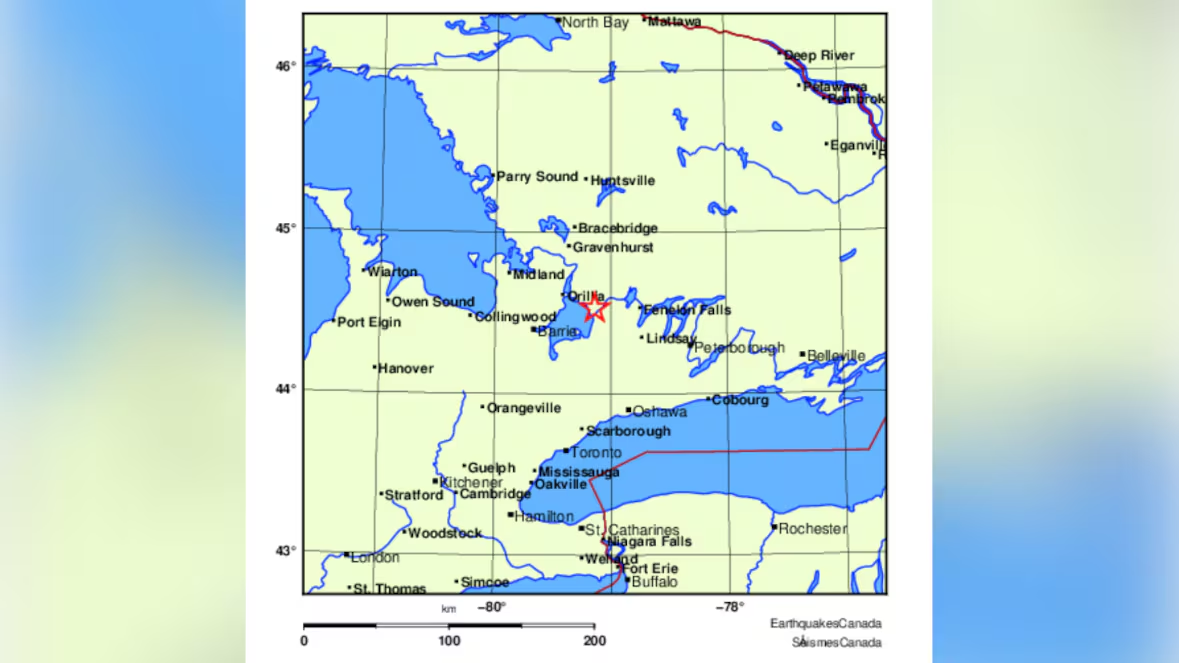
The earthquake began about 23 kilometers southeast of Orillia, Ontario. Earthquakes Canada
A late-night earthquake startled thousands of people across southern and central Ontario on Tuesday, prompting reports from communities spread far and wide. According to Natural Resources Canada, the quake struck just before 11 p.m. Eastern Time and measured a magnitude of 3.7.
Earthquakes Canada said the tremor occurred about 99 kilometers northeast of Toronto. Its center sat roughly 23 kilometers southeast of Orillia, Ont., at a depth of five kilometers. Officials described the shaking as light but noticeable.
Thousands report feeling the shake
As of Wednesday morning, more than 2,600 people had reported feeling the quake, said Natural Resources Canada seismologist Marikah Adams. Reports came from as far west as Kitchener, through Toronto, and east to Kingston and Belleville. People in Niagara Falls also said they noticed the shaking.
More reports continued to arrive as residents shared their experiences online and through official reporting tools.
Residents describe sudden noise and movement
For some, the quake arrived with a loud surprise. Sarah Cowley, an artist who lives in Beaverton, said she heard a “roaring sound” when the shaking began.
“Now I live in an old home. It's 120 years old. It's sturdy, but all the floors were shaking,” she said. Cowley added that when she looked outside, she saw no fallen trees or visible damage. While she remained shaken by the experience, her husband slept through the event.
No damage reported so far
Authorities reported no injuries or damage following the quake. Records show the same area has seen two similar earthquakes over the past 25 years. The strongest quake in the region occurred in 1929 and measured 5.5.
Why earthquakes happen here
Earthquakes remain uncommon in this part of Ontario. Adams explained that the region sits in the middle of the North American tectonic plate, far from plate boundaries where most earthquakes occur.
“We don't know if there's going to be any follow-up events, but it's highly unlikely,” she said.
Scientists believe pressure can build over long periods near old faults or cracks deep underground. When that pressure releases, it can cause small earthquakes.
Geologist Lindsay Schoenbohm said these events sometimes earn the nickname “snap, crack, pop earthquakes” because of how they release built-up stress.
Safety reminders for the public
Although rare, earthquakes can happen anywhere, Adams said, and people should stay calm. “A good thing to remember if you do experience an earthquake is to stop, drop, cover, and hold on,” she said. People indoors should take cover under a sturdy table or bed, while those outside should move away from buildings.
Schoenbohm added that standing in doorways is no longer recommended, as the advice comes from outdated guidance.
Different readings, same event
American monitoring agencies measured the quake slightly differently, recording it as a magnitude 4.1 at a deeper level. Seismologist Stephen Crane said variations occur because different stations and scales measure earthquakes differently.
He said Earthquakes Canada remains the main source for information on quakes within the country.
For Cowley, the experience served as a reminder of nature’s power. “There are some things we can control and some things we can't,” she said.