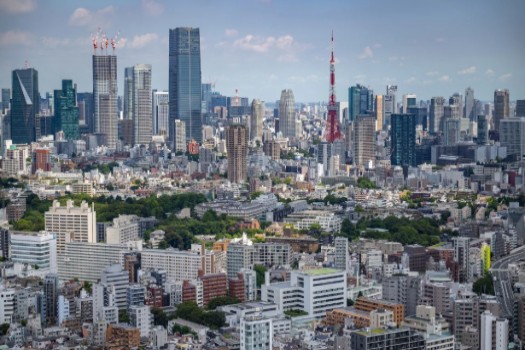
A photo showing Tokyo's skyline on September 11, 2024.
Japan’s population decline is accelerating at an alarming pace. According to the latest data from the health ministry, the number of babies born in 2024 dropped to a new record low, intensifying concerns over the country's future.
Births Fall Below 700,000 for the First Time
In 2024, only 686,061 babies were born in Japan—a 5.7% drop compared to the previous year. This is the lowest number recorded since tracking began in 1899 and the 16th consecutive year of decline. It marks a stark contrast to the postwar baby boom of 1949, when 2.7 million births were recorded.
Fertility Rate Hits Historic Low
Japan’s fertility rate—the average number of children a woman is expected to have—also slid to 1.15 in 2024, down from 1.2 in 2023. This rate is far below the 2.1 needed to sustain a stable population. Despite a slight rise in marriages to 485,063, the long-term downward trend has continued since the 1970s.
A Silent Population Emergency
Prime Minister Shigeru Ishiba has called this a "silent emergency." The government is attempting to address it with policies promoting flexible working conditions, particularly in rural areas. However, the measures are falling short.
Experts argue the focus remains too heavily on supporting married couples, while ignoring the core issue—young people are increasingly avoiding marriage and parenthood altogether.
Cultural and Economic Barriers
Many young Japanese cite unstable job prospects, the high cost of living, and rigid gender roles in the workplace as key reasons for their reluctance to start families. Women, in particular, face overwhelming pressure to conform to traditional roles.
Additionally, Japan’s law requiring married couples to adopt a single surname continues to deter many women from tying the knot. In most cases, women are expected to take their husband’s name, which some view as outdated and unfair.
Not Just Japan—An East Asian Struggle
Japan’s declining birth rate mirrors challenges faced by other East Asian nations like South Korea and China, where governments have also struggled to reverse population shrinkage. Meanwhile, Vietnam recently repealed its two-child policy in an attempt to address similar concerns.
A Shrinking Future
Japan’s current population stands at approximately 124 million. However, projections show it could plummet to 87 million by 2070. By then, 40% of the population is expected to be over the age of 65, leading to massive strain on healthcare, pensions, and the workforce.
Japan at a Demographic Crossroads
The population crisis in Japan is more than a number—it’s a national alarm. If the trend continues, the country faces severe consequences for its economic stability, workforce availability, and national security.
Government initiatives must evolve beyond surface-level solutions. Without deeper cultural reforms and stronger support for younger generations, Japan’s population emergency will only grow louder.