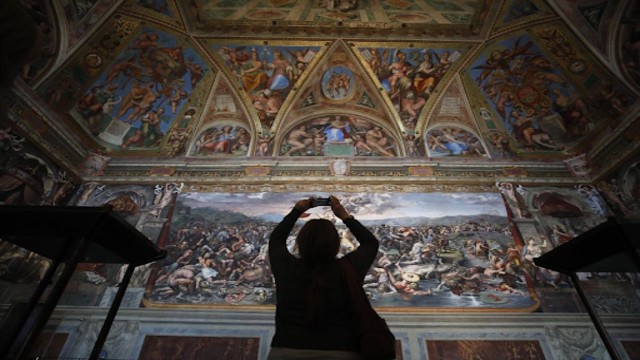
A visitor admires a Raphael Room inside the Vatican Museums at the Vatican, on May 3, 2021. (AP Photo)
After a decade of meticulous restoration, the Vatican Museums have finally lifted the curtain on a long-awaited masterpiece—The Room of Constantine, the last and largest of the famed Raphael Rooms.
This unveiling not only marks the completion of a significant conservation effort but also rewrites a vital chapter in Renaissance art history.
A Restoration That Changed the Story
What began as a straightforward cleaning turned into a revelation. As conservators delicately worked through layers of centuries-old dust and grime, they stumbled upon something extraordinary—Raphael had used oil paints directly on the walls.
Until now, it was believed that frescoes, where pigment is applied to wet plaster, dominated these rooms. But hidden in two female figures—Justice and Courtesy—experts confirmed a rare technique: oil on wall. This subtle but groundbreaking discovery pointed to the master’s direct hand and his experimental brilliance.
A Vision Interrupted by Untimely Death
Raphael, summoned to the Vatican by Pope Julius II in 1508, was only 25 when he began the prestigious commission. The young Florentine artist had been tasked with decorating the Pope’s private apartments inside the Apostolic Palace.
Though his vision for The Room of Constantine was bold and unconventional, Raphael would never see it finished. He died prematurely in 1520 at the age of 37. The remaining sections were completed by his students using traditional fresco techniques. They tried but failed to replicate the same innovation Raphael had started.
Unseen Clues in the Walls
What tipped off Vatican restorers to the oil painting was a deeper investigation during cleaning. They noticed a strange grid of nails embedded beneath the plaster. These weren’t random—they had a purpose. Experts believe Raphael inserted the nails to anchor a resin layer, onto which he could paint with oils.
This rare experiment in mural technique had never been found in any other Renaissance wall painting. According to chief restorer Fabio Piacentini, it was both a historical and technical breakthrough. It proved that Raphael had begun to push the boundaries of what wall art could be.
A Ceiling That Tells Its Own Story
While Raphael’s vision dominated the walls, the ceiling of The Room of Constantine had its own artistic glory. It was completed by Tommaso Laureti, who painted an optical illusion masterpiece—The Triumph of Christianity over Paganism. His work masterfully used perspective to create the effect of a massive, draped tapestry overhead.
A Gift to Jubilee Visitors
Although the Raphael Rooms remained partially open during the restoration, the experience was incomplete. Now, with scaffolding finally removed, visitors can take in the full splendor of the rooms just in time for the Vatican’s 2025 Jubilee year.
As Vatican Museums director Barbara Jatta summed up: “With this restoration, we rewrite a part of the history of art.” And indeed, the rediscovered legacy of Raphael’s brush now lives on—not only in what he finished, but in what he dared to begin.