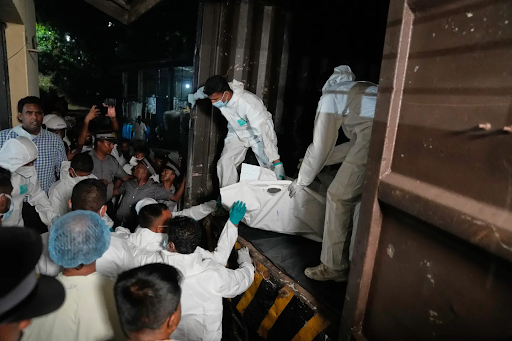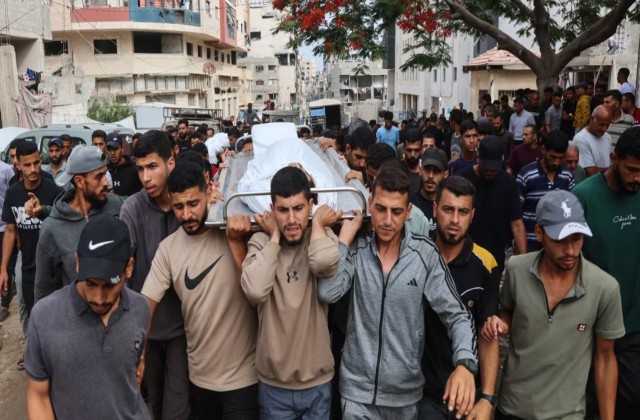
Palestinians carry the body of a man killed a day earlier while attempting to get aid at a distribution point near the Israeli-controlled Zikim border crossing, during a funeral procession at Al-Shifa hospital in Gaza City on June 23, 2025.
Tensions are escalating in Gaza as reports emerge of deadly shootings near food aid distribution centers. The Israeli military is facing sharp criticism following multiple incidents in which Palestinians were reportedly killed while attempting to access humanitarian aid.
A recent article published by the Israeli daily Haaretz claims that Israeli Defense Forces (IDF) soldiers were ordered to fire at unarmed Palestinians approaching aid trucks. The report cites anonymous soldiers describing the aid routes as “killing fields,” alleging that troops fired even when no threat was present.
IDF and Government Deny Accusations
The Israeli military has strongly denied these allegations. In a statement, the IDF said, “We strongly reject the accusation raised in the article. The IDF did not instruct forces to deliberately shoot at civilians.”
Prime Minister Benjamin Netanyahu and Defense Minister Israel Katz echoed this defense, dismissing the report as “vicious lies” meant to damage the IDF’s reputation. They stood by the military’s claim of having “the most moral army in the world.”
Casualties Continue to Mount
Despite these denials, the death toll keeps rising. According to the Palestinian Ministry of Health, over 500 Palestinians have been killed near aid sites since May 27. Eyewitnesses, including survivors, described Israeli gunfire targeting crowds without warning.
CNN verified some of these claims through videos and interviews. Weapons experts also confirmed that the bullet casings and the gunfire patterns matched Israeli military machine guns.
IDF Admits to 'Warning Shots'
While rejecting the allegations of intentional targeting, the IDF has admitted to firing what it calls “warning shots” when crowds approach too closely to military positions. However, it has yet to publicly share any results from internal reviews regarding these incidents.
The Military Advocate General has since instructed the IDF’s Fact-Finding Assessment Mechanism to investigate whether these actions violate international law. “Any allegation of a deviation from the law or IDF directives will be thoroughly examined,” the military stated.
Controversy Surrounds Aid Distribution by GHF
The Gaza Humanitarian Foundation (GHF), an Israel- and US-backed group, manages the distribution of food at designated locations in Gaza. Since its launch, the aid process has been chaotic. Desperate crowds often surge the sites as soon as they open, hoping to secure aid before supplies run out—usually in under an hour.
GHF was formed as a replacement for the United Nations aid mechanism, which Israel and the US accused Hamas of exploiting. While Hamas denied the allegations, humanitarian groups have stated that most UN aid did reach civilians.
GHF Urges Transparency
In response to the Haaretz report, GHF said it was “not aware” of the specific incidents involving alleged shootings. Still, the group acknowledged the severity of the claims and urged Israeli authorities to launch a transparent investigation.
“These allegations are too grave to ignore,” a GHF spokesperson said. “We call on Israel to investigate them and publish the results.”
US Continues to Support GHF
Amid growing scrutiny, the US State Department announced a $30 million funding boost to GHF. The organization claims it has distributed 46 million meals in just four weeks. Despite ongoing criticism from aid experts and humanitarian organizations, this financial backing shows that US support for GHF remains firm.
Ongoing Crisis Demands Urgent Action
The situation in Gaza remains dire. While aid groups scramble to feed starving civilians, reports of violence continue to surface. Calls for accountability and transparency are growing louder, with both international observers and local communities demanding answers.
As investigations begin, the world watches closely. Lives are on the line, and humanitarian principles hang in the balance.