

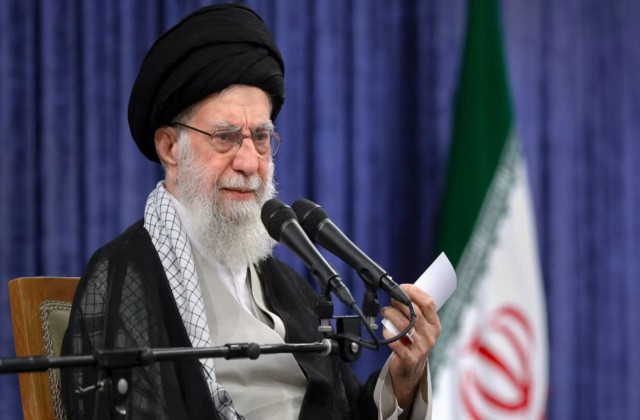
Iranian Supreme Leader Ayatollah Ali Khamenei speaks during a meeting in Tehran on May 20.
For more than 35 years, Iran’s Supreme Leader Ayatollah Ali Khamenei has faced everything from economic turmoil to war.
But the recent coordinated military strikes by Israel and the United States have pushed his regime to the brink. This moment may be the most severe test of his rule — and survival — with few viable paths forward.
A Direct Hit to Iran’s Power Core
The scale of the damage remains uncertain, but its impact is deeply felt. Israel’s assault struck Iran’s Revolutionary Guard Corps, killing key commanders. Nuclear facilities, critical to Iran’s uranium enrichment efforts, were damaged. Several leading nuclear scientists were assassinated. These attacks reached into the very foundation of Khamenei’s power.
Billions invested in the nuclear program evaporated in less than two weeks. Proxy militias, once powerful arms of Iran’s regional strategy, have been significantly weakened. Combined with Western sanctions and economic hardship, the blow is severe.
Supreme Leader in Hiding
Khamenei did not appear in public during the attacks. Instead, he addressed the nation from an undisclosed location. His absence from the funerals of fallen commanders raised further questions about his health and security.
Only after a ceasefire was in place did he release a defiant video statement, accusing the US of demanding Iran’s total surrender. Former President Donald Trump fired back, mocking Khamenei’s claims of victory, saying, “You got beat to hell.”
Diminishing Power of an Aging Leader
Khamenei, now 86, once navigated crises with skill. Today, he presides over a rigid system showing clear signs of decline.
With no chosen successor and an uncertain political future, his options have narrowed. The regime can either double down or risk reforms that could challenge its very structure.
A History of Resistance
Khamenei’s leadership has always been defined by resilience.
He took power after Iran’s devastating war with Iraq. He kept the Islamic Republic afloat despite internal divisions, sanctions, and global isolation. His rule has relied on tight control, often enforced through harsh crackdowns on dissent.
Protests over women’s rights and election fraud have shaken Iran. Intelligence leaks, cyberattacks, and assassinations — largely credited to Israel — exposed the vulnerability of his security apparatus. But never before had a US president hinted at Khamenei’s assassination, or had foreign powers attacked Iranian soil this directly.
The Collapse of Deterrence
These latest strikes mark only the second time Iran has been attacked by foreign forces since the 1979 Islamic Revolution.
Khamenei’s key tools of deterrence — a robust nuclear program and proxy militias surrounding Israel — now appear severely compromised.
He still holds authority through deeply loyal institutions. But as Iran reels from loss and uncertainty, the regime may respond by tightening its grip to preserve its conservative Islamic ideals.
“Iran’s doctrine of projecting power and deterring enemies has faltered,” said Ali Vaez, Iran Project Director at the International Crisis Group. “The regime survives, but clearly weakened.”
Nuclear Path Ahead?
With external pressure mounting, there are signs Iran may pivot on its nuclear stance. Parliament recently moved to halt cooperation with the UN’s nuclear agency. Though Khamenei once forbade the development of nuclear weapons, that could change as Iran seeks stronger deterrence.
While Iran has long claimed its nuclear program is peaceful, Trump said he would not hesitate to strike again if uranium enrichment resumes at dangerous levels.
A Nation United, But for How Long?
Khamenei described the Iranian people as “shoulder to shoulder,” unified in their defiance. This rare moment of national unity could offer an opening for reform. But Khamenei has shown little appetite for systemic change.
Any reconciliation with the West is unlikely soon. Despite recent overtures from Arab neighbors, and offers from the Trump administration to support Iran’s civilian nuclear energy efforts, deep mistrust prevails. Iran’s leaders bristle at the tone of Trump’s rhetoric — especially personal threats aimed at Khamenei.
“If President Trump wants a deal, he must stop the disrespect,” said Iran’s Foreign Minister Abbas Araghchi on X.
The Fight to Save a Regime
In his latest address, Khamenei struck a tone of defiance, signaling that military force alone will not bring down Iran. But the Islamic Republic stands at a crossroads. With his power weakened and succession uncertain, Khamenei must now make a decision that will shape Iran’s future — rebuild what’s been lost or begin a dangerous transformation.













