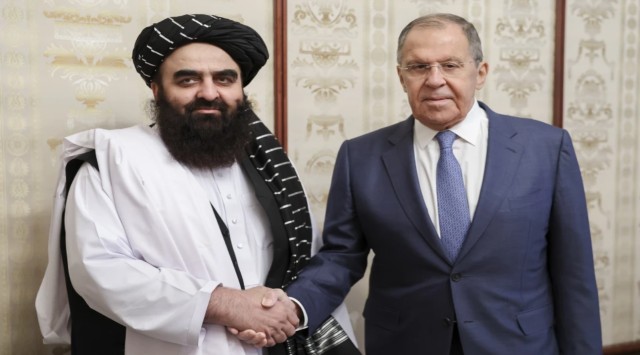
In this photo released by Russian Foreign Ministry Press Service on Oct. 4, 2024, Russian Foreign Minister Sergey Lavrov, right, and Acting Foreign Minister of Afghanistan’s Taliban movement Amir Khan Muttaqi pose for a photo prior to their talks in Moscow, Russia.
In a bold diplomatic move, Russia has officially recognized the Taliban’s rule in Afghanistan, becoming the first nation to do so since the group seized power in 2021. The announcement marks a historic shift in global politics and is expected to influence other countries’ future engagement with the Taliban regime.
Russia Grants Official Status to Taliban Government
On Thursday, the Russian Foreign Ministry confirmed it had received credentials from Afghanistan’s newly appointed ambassador, Gul Hassan Hassan. This act of formal acceptance signals Russia’s recognition of the Taliban-led administration as the legitimate government of Afghanistan.
According to a ministry statement, the move aims to encourage “productive bilateral cooperation” between the two countries.
Afghanistan’s Foreign Ministry welcomed the decision, calling it a “historic step.” Taliban Foreign Minister Amir Khan Muttaqi praised Russia’s move, describing it as “a good example for other countries” to follow.
Taliban’s Struggle for Recognition Ends With a Breakthrough
The Taliban took control of Afghanistan in August 2021 after the withdrawal of U.S. and NATO forces. Since then, the group has struggled to gain formal recognition on the global stage despite establishing diplomatic ties with some countries, including China and the UAE.
Until now, no nation had officially recognized the Taliban government, mainly due to concerns over human rights, especially restrictions on women and girls.
Russia’s decision breaks that barrier, potentially paving the way for other countries to reassess their stance toward the Taliban administration.
Women's Rights Concerns Remain Unresolved
The Taliban had initially promised a more moderate form of governance compared to their earlier rule from 1996 to 2001. However, these promises were short-lived.
Since their return to power, the Taliban have barred women from most jobs and public places, including parks, gyms, and baths. Girls are also banned from studying beyond sixth grade, drawing global criticism.
These policies remain a significant barrier to broader international recognition. However, Russia appears to be prioritizing regional stability over domestic policies in Afghanistan.
Russia’s Strategic Shift on the Taliban
Russia had previously listed the Taliban as an outlawed organization. But in April this year, it lifted the ban, signaling a strategic shift in its foreign policy toward Afghanistan.
Russia’s ambassador to Afghanistan, Dmitry Zhirnov, said the recognition was approved by President Vladimir Putin, based on a recommendation from Foreign Minister Sergey Lavrov.
In a statement broadcast on state television, Zhirnov said the decision shows Russia’s “sincere striving for the development of full-fledged relations with Afghanistan.”
This move reflects Moscow’s broader goal of ensuring stability in the region and avoiding the spillover of extremism into neighboring Central Asian states.
A Potential Domino Effect?
With Russia now officially recognizing Taliban rule, the geopolitical landscape around Afghanistan could shift. Countries that were previously hesitant may now reconsider their positions, especially if diplomatic and economic interests are at stake.
However, concerns over human rights, especially women's rights, will continue to challenge the Taliban’s pursuit of international legitimacy.
Russia’s bold step may spark both support and criticism globally, but it undeniably marks a turning point in Afghanistan’s international relations.