

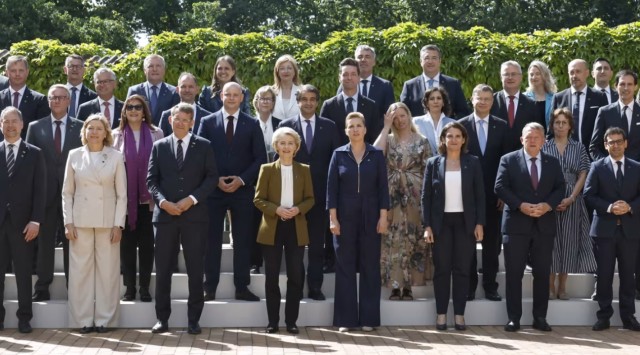
Denmark's Prime Minister Mette Frederiksen (front, center right), with European Commission President Ursula von der Leyen (front, center left) and other ministers pose for a photo during the official opening of Denmark's European Union presidency in Aarhus, Denmark, on July 3, 2025.
Denmark, once cautious about deeper ties with the European Union, is now embracing a stronger European identity. As it assumes the rotating presidency of the EU, Danish public opinion has undergone a dramatic transformation — one that experts say has been heavily influenced by U.S. President Donald Trump’s recent actions and rhetoric.
Danes Turning to Europe for Security
A recent survey by Danish daily Berlingske highlighted the shift: 41% of Danes now view the U.S. as a threat. Meanwhile, 92% believe Denmark should depend more on the EU — not the U.S. — for its security. This marks a remarkable departure for a country that has traditionally seen itself as staunchly transatlantic.
Political tensions between Washington and Copenhagen have deepened this divide. Trump’s repeated interest in buying Greenland, a self-governing territory under Danish sovereignty, has unsettled many Danes. U.S. Vice President JD Vance’s visit to the Pituffik Space Base in March further inflamed sentiments, especially after he accused Denmark of neglecting Arctic defense responsibilities. Prime Minister Mette Frederiksen firmly responded, reaffirming Denmark's commitment to being a "good and strong ally."
The Trump Effect on Danish Foreign Policy
According to Lykke Friis, a prominent Danish political analyst and former minister, Denmark is dealing with what she calls a “triple shock” — the Ukraine war, Brexit, and Trump’s second term. But Trump’s unpredictability, Friis said, has had the most profound impact.
“We used to be a very, very transatlantic country… that has plummeted,” she said. The growing sentiment is that Trump cannot be trusted.
Marie Bjerre, Denmark’s Minister for European Affairs, echoed that view. Without naming Trump, she acknowledged a shift in Denmark’s view of its long-time ally. Bjerre pointed out that the U.S. is now “closing in on itself,” using threats of tariffs and criticizing Europe’s core values — from freedom of expression to policy-making.
In her words, “The world order is changing, and we must adapt to this new geopolitical reality.”
A Strong Ally Left Unappreciated
The sense of betrayal runs deep. Denmark has consistently supported U.S. military efforts, from Iraq to Afghanistan. With 43 soldiers lost in Afghanistan, Denmark had one of the highest per capita casualty rates among U.S. allies. Yet recent comments from Trump and his administration have made Danes feel underappreciated and unfairly criticized.
“You couldn’t put a paper between us and the U.S.,” Bjerre said, expressing frustration at the erosion of trust. The change in tone, particularly from Prime Minister Frederiksen — once skeptical of EU integration — has been striking.
Euroskeptic to Eurostrong: A New Danish Era
Historically, Denmark maintained a cautious, even skeptical, stance toward the EU. It opted out of the euro and retained independence in several EU policy areas. Concerns about Brussels overreaching into Danish labour markets and daily life were widespread.
Now, the fear has flipped.
“Earlier, we feared the EU was too powerful. Now, we fear it’s too weak,” said Friis. The growing threats from both Russia and Trump’s America have prompted a reevaluation of the EU’s role as a stabilizing force.
In June, Frederiksen announced Denmark’s exit from the so-called “Frugal Four,” a group of EU nations skeptical of joint spending. Her message was clear: Europe must rearm, and Denmark is ready to lead by example.
EU Trust Soars Amid Global Uncertainty
According to EU-commissioned polls, trust in the European Union among Danes has surged — from 46% in 2005 to 74% in 2024. Significant spikes were recorded during Trump’s first term, following the Ukraine invasion, and with Trump’s re-election.
“The war in Ukraine changed everything,” said Friis. “It made the threat feel immediate. People are prepping now. They’re scared about Denmark’s own security.”
With Copenhagen now leading the EU Council, Bjerre emphasized that Denmark’s presidency will focus on “a stronger Europe in a changing world,” prioritizing defense and unity across the bloc.
Navigating an Uneasy Transatlantic Future
Denmark steps into this leadership role with a renewed commitment to the EU and cautious distance from its American ally. But the challenge ahead remains complicated. The EU still needs to engage with the U.S. — especially on critical issues like Ukraine, defense spending, and transatlantic trade.
At the heart of this evolving relationship is a lingering question: Can Denmark — and the EU — forge a future that stands strong on its own, even as old alliances fray?
The answer may well define Europe’s next chapter.













