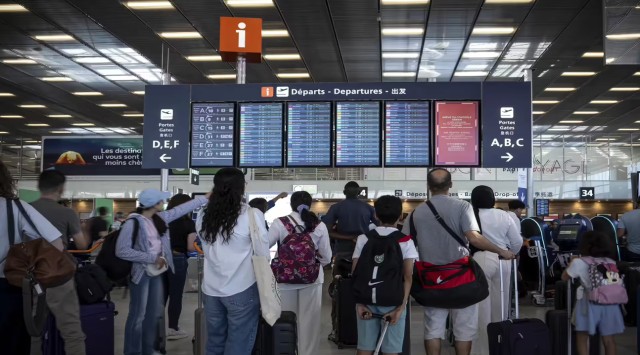
Passengers look at the departures information board at Orly airport, near Paris, as French air traffic controllers launched a two-day strike to demand better working conditions.
A major strike by French air traffic controllers has thrown Europe’s summer travel season into disarray. The industrial action, driven by demands for better working conditions, forced airlines to cancel nearly 40% of flights in and out of Paris on Friday, causing frustration and confusion for thousands of passengers.
Flights Cancelled at Key Airports
The disruption began on Thursday but escalated quickly by Friday morning. France’s civil aviation authority directed airlines to cancel a significant portion of scheduled services, including:
- 40% of flights at Paris Charles de Gaulle, Orly, and Beauvais airports
- 50% at Nice Airport
- 30% at airports in Marseille, Lyon, and several other cities
Even with advanced cancellations, authorities issued a stern warning: “Passengers should expect significant disruptions and long delays at all French airports.”
Airlines Hit Hard, Ryanair Demands Action
Several major carriers bore the brunt of the chaos, including Ryanair. The budget airline cancelled over 400 flights, impacting approximately 70,000 passengers.
In a statement, Ryanair condemned the disruption caused by the strike and urged the European Union to step in. “We call on the EU to reform air traffic rules to prevent overflights from being disrupted by localized industrial action,” the airline said.
The airline noted that the strike affects not only flights to and from France but also those merely passing over French airspace. The widespread impact left travelers stranded and scrambling for alternatives.
Union Says Staffing and Pay Are the Core Issues
The air traffic controllers’ union, UNSA-ICNA, defended the strike. In a statement, the union cited two major issues: insufficient staffing to handle the summer surge in travel and the impact of inflation on wages.
Additionally, workers are protesting new reform measures introduced after a near mid-air collision at Bordeaux Airport.
These measures reportedly involve increased monitoring and stricter regulations on air traffic staff—something the union claims adds pressure without solving core safety issues.
Government Reacts, Calls Timing “Unacceptable”
French Transport Minister Philippe Tabarot condemned the strike's timing. With schools just closing for the summer and many families beginning their vacations, the minister called the action “unacceptable and poorly timed.”
He emphasized the inconvenience caused to ordinary citizens, many of whom were traveling with children or elderly family members.
Passenger Frustrations Mount
For travelers, the strike has been more than just an inconvenience—it’s turned into a logistical nightmare.
Mariano Mignola, visiting Paris with his wife and children from Naples, had his return flight cancelled. “We found out at check-in that something was off,” he said. “We checked the airport’s website and saw our flight was cancelled. We hoped the airline would help with accommodations, but nothing.”
Mignola added, “There’s no support, no alternative. We can’t even find a rental car to drive back.”
For others like Parisian Patrick Haus, who was due to attend a business meeting in Nice, the situation was bittersweet. “I’m angry, of course,” he said, “but I also understand. People don’t strike for fun. It’s a sign something’s wrong.”
Air Travel Disruption in France: A Growing Pattern?
This is not the first time France’s aviation sector has experienced turbulence due to labour strikes. However, this particular walkout comes at a peak moment, just as summer travel ramps up and the tourism industry rebounds post-pandemic.
With growing unrest among air traffic controllers and no resolution yet in sight, passengers across Europe may have to brace for more flight disruptions.
The need for dialogue between unions, government, and airline companies has never been more urgent to prevent such large-scale air travel disruption in France from becoming a summer norm.