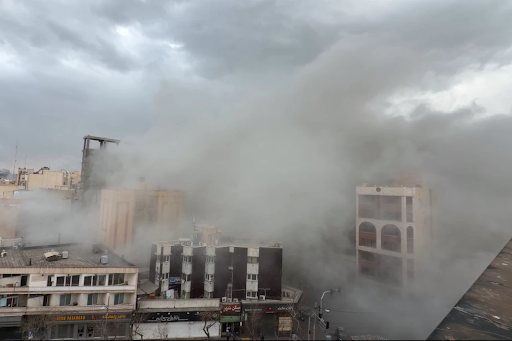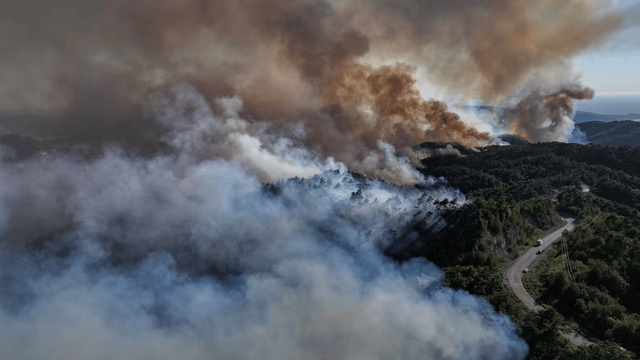
Smoke rises into the sky during a wildfire in the town of Rabia, Syria, in the Latakia countryside, on Saturday.
Massive wildfires have swept across Syria’s drought-stricken coastal mountains, turning the Jabal Turkman region into a blazing inferno. Since Thursday, the fires have destroyed thousands of hectares of forest, testing the limits of Syria’s emergency services and the resolve of its new government.
Forest Fires Add to Syria’s Ongoing Struggles
The wildfires erupted at a time when Syria is already battling numerous crises. After over a decade of war, economic sanctions, and failing infrastructure, this new environmental disaster adds to the burden.
The fire line stretches over 20 kilometers (12 miles), with thick smoke and flames cutting off roads, knocking out power, and forcing thousands of residents to flee. Rugged terrain and high winds have made firefighting operations extremely difficult. Even worse, hidden landmines left from years of conflict pose a deadly threat to emergency teams.
Civil Defense Battles Unforgiving Conditions
Abdel Kafi Kayyal, civil defense chief in Lattakia province, described the blaze as “extremely difficult” to control. He told CNN that the region’s mountainous topography, combined with strong winds and bone-dry vegetation, has made containment nearly impossible. Over 60 firefighting units have been mobilized, but the fire has now spread into neighboring Tartous province.
Drone footage reveals a harrowing scene—wildfires racing through tinder-dry woodlands, surging unpredictably as gusts of wind carry embers across the terrain.
International Aid Joins Firefighting Efforts
With resources stretched thin, Syrian authorities have issued international appeals for help. In response, Turkey dispatched two helicopters and 11 firefighting trucks. On Sunday, Jordanian civil defence teams arrived on the ground to support firefighting efforts. These reinforcements are crucial, but the sheer scale of the wildfire is daunting.
Satellite data from NASA’s FIRMS (Fire Information for Resource Management System) paints a grim picture. The fires have scorched more than 180 square kilometers—an area larger than the city of Damascus.
Forest Loss Raises Environmental Alarm
According to Syrian government figures from 2023, the nation’s forest cover spans roughly 5,270 square kilometers. In just three days, more than 3% of that forest has gone up in flames. This rapid loss of woodland is a devastating blow to the country’s already fragile ecosystem.
The fires also worsen the impact of Syria’s ongoing drought. Last year, the Carnegie Endowment for International Peace highlighted alarming climate trends. The Euphrates Basin—particularly in the southern and eastern desert regions—has suffered from extreme heat and low rainfall for four consecutive years. These dry conditions have left forests highly flammable and susceptible to rapid fire spread.

Smoke billowing from a forest fire in the coastal Syrian province of Latakia on Saturday.
New Government Faces Major Challenge
These wildfires are a critical early test for Syria’s new leadership. With basic services in disrepair and public trust still fragile after years of war, how the government handles this disaster could define its credibility.
So far, the coordination between local teams and international aid is ongoing. However, the situation remains unpredictable. Many areas remain inaccessible, and the full extent of the damage is yet to be assessed.
Nature’s Fury Meets Human Fragility
The wildfires in Syria are more than a natural disaster—they are a harsh reminder of the nation’s vulnerability. As flames devour forests and homes, the country’s hopes for stability and recovery face another major setback. The coming days will be crucial in determining whether the new government can rise to the challenge or be overwhelmed by it.