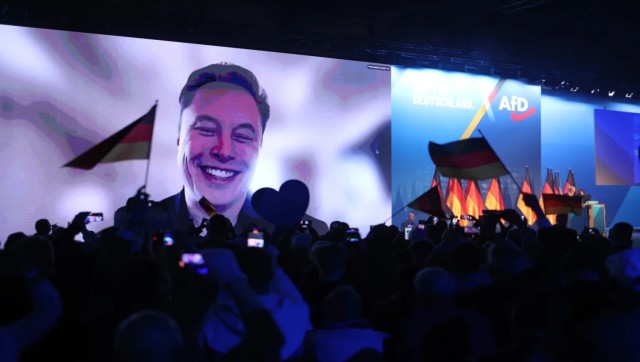
Tech billionaire Elon Musk speaks live via a video transmission during a speech by party co-leader Alice Weidel in February.
Germany’s far-right Alternative for Germany (AfD) party has found itself at the center of a heated national debate. While its popularity continues to surge, reaching record-high poll numbers, political and legal forces are working to ban the AfD, labeling it a threat to democracy.
AfD Gains Ground Despite Extremism Label
After securing 20.8% of the national vote in February’s election, the AfD became Germany’s largest opposition group. At one point, it even overtook Chancellor Friedrich Merz’s center-right CDU in national polls. But this rising popularity has come with heightened scrutiny.
In May, Germany’s domestic intelligence agency — the Federal Office for the Protection of the Constitution (BfV) — officially designated the AfD as an extremist entity. A 1,100-page report outlined accusations of racism, anti-Muslim rhetoric, and the devaluation of entire segments of society.
This formal classification not only intensified surveillance of the party but also reignited efforts to outlaw the AfD, with the center-left Social Democratic Party (SPD) calling for a complete ban.
Legal Path to Ban the AfD Is Complex
Germany’s political system, rooted in "militant democracy" (streitbare Demokratie), allows the banning of political parties that threaten democratic order. But this can only happen under strict legal conditions.
Two key criteria must be met:
1.
The party must demonstrate aggressive intent against democratic principles.
It must be popular enough to pose a real danger — known as the “potentiality” rule.
Till Holterhus, a constitutional law expert, believes the AfD meets both criteria. “Its size demonstrates that it fulfills the criterion of ‘potentiality,’” he noted.
However, initiating a ban involves a lengthy process. The Federal Constitutional Court must first approve a formal request submitted by the Bundestag, the Bundesrat, or the federal government. This triggers a full trial, with thousands of pages of evidence, witness testimonies, and a final ruling by a two-thirds majority of the court’s judges.
A Ban Would Have Wide-Ranging Effects
If banned, the AfD would be dissolved and barred from all political activities. Its lawmakers in the Bundestag, regional assemblies, and the European Parliament would lose their mandates.
Out of the 152 Bundestag seats the AfD currently holds:
42 are direct mandates — requiring fresh elections in those districts.
110 are party list seats — which would remain vacant until the next national vote.
This would alter Germany’s parliamentary balance, amplifying the influence of other parties.
The court has rarely used this power. Only two political parties have ever been banned — both in the 1950s: the neo-Nazi Socialist Reich Party and the Communist Party of Germany.
Attempts to ban other extremist parties, like the neo-Nazi NPD, have failed due to insufficient threat levels, despite their unconstitutional nature.
Risk of Backlash and Radicalization
While legal and political justification for a ban grows, many warn that such a move could backfire. The AfD’s rising support — fueled partly by figures like Elon Musk and U.S. officials such as JD Vance and Marco Rubio — suggests that banning it might reinforce its victim narrative.
Some fear that a ban could trigger a “martyr effect,” fueling further radicalization or even violence. Holterhus warned that prolonged proceedings could give the AfD a larger platform, and risk being portrayed by populists as a move against democratic values.
Chancellor Merz and his CDU have remained cautious. Interior Minister Alexander Dobrindt also pushed back against the SPD’s urgency, warning against premature action.
Public Protest Meets Political Paralysis
Despite political hesitance, public opposition to the AfD is growing. In early 2024, tens of thousands protested after reports surfaced of senior AfD members discussing mass deportation plans. The movement to ban the party has gained momentum since then.
Still, Germany’s leaders remain divided. The challenge is balancing the need to protect democracy without undermining its core values. Whether the AfD is ultimately banned or not, the debate underscores a broader struggle within Germany — between defending democratic order and upholding political freedom.