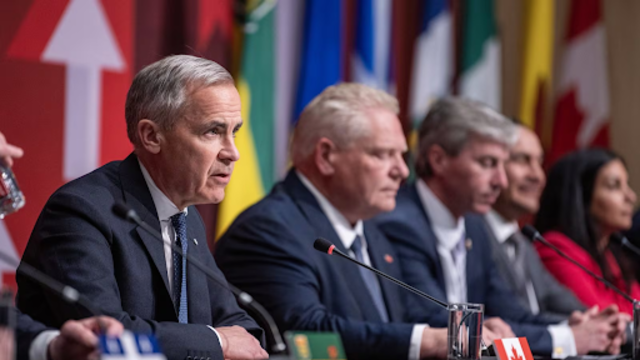
Prime Minister Mark Carney, left, speaks to media. The Canadian Press
Just ahead of this week’s internal trade talks in Quebec City, a new report is challenging the big promises tied to eliminating Canada’s interprovincial trade barriers. While government leaders are pushing for a more unified national economy, the Canadian Centre for Policy Alternatives (CCPA) says the campaign may be more performance than progress.
Bold Promises, Thin Results
Prime Minister Mark Carney has championed the idea of "one Canadian economy" since the spring election. His plan includes working with provincial premiers to eliminate barriers that restrict the movement of goods and labour between provinces. The goal? Strengthen Canada's internal market and counteract external pressures like U.S. tariffs.
Carney isn't alone in this mission. Internal Trade Minister Chrystia Freeland has repeatedly cited research estimating that these trade restrictions are the economic equivalent of a seven per cent self-imposed tariff. Removing them, she says, could inject as much as $200 billion into the economy.
But according to the CCPA, these numbers are more headline-friendly than reality-based.
Political Theatre Over Practical Change
The think tank’s report, released Tuesday morning, paints a less flattering picture of recent government efforts. It argues that despite the lofty rhetoric, real progress on breaking down trade barriers remains minimal. The study suggests that Ottawa and the provinces have only managed to agree on a few concrete changes—and none are significant enough to dramatically impact the national economy.
Researchers behind the report claim that the most commonly cited benefits are drawn from limited or overlapping regulation fixes. These are more symbolic wins than sweeping reforms. In short, the think tank believes politicians are overstating the benefits and underdelivering on the action.
A Timely Reality Check
The timing of this report is critical. Trade ministers from across the country are gathering in Quebec City to map out the next steps in tearing down internal trade walls. With business groups and economists watching closely, pressure is high to show that progress is real—not just political optics.
Still, the CCPA’s findings raise tough questions. If only a few trade barriers have been lifted, and the economic payoff is still unclear, are Canadians being sold an oversimplified solution to a complex problem?
What’s Really at Stake?
Canada’s internal trade restrictions have long frustrated businesses, especially smaller ones trying to expand beyond their home province. And while reducing red tape is a popular promise during elections, follow-through often stalls in the face of provincial differences.
The new report argues that genuine reform requires deeper cooperation, not just press conferences and bold estimates. If leaders are serious about building one seamless Canadian economy, they’ll need to dig far beyond surface-level changes.
As the ministers meet this week, the spotlight is on whether real progress will emerge—or if, once again, political theatre will take center stage.