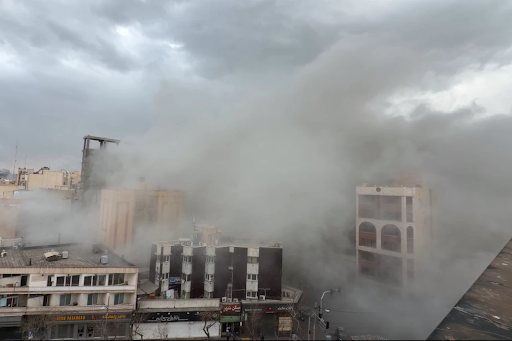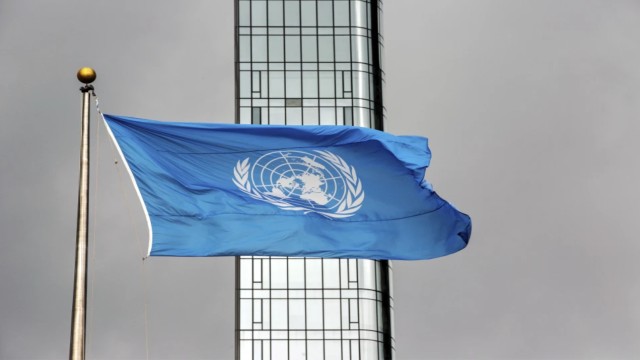
The United Nations flag flies on a stormy day at the U.N. during the United Nations General Assembly, Sept. 22, 2022.
Tensions are rising again over Iran’s nuclear program. The United Kingdom, France, and Germany have warned they will reinstate United Nations sanctions on Iran by the end of August if there is no significant movement on a nuclear agreement. The threat signals growing impatience among European powers as diplomatic talks stall.
A United Warning Over Iran's Nuclear Ambitions
In a meeting at Germany’s U.N. Mission on Tuesday, the ambassadors from the UK, France, and Germany reviewed the status of Iran’s nuclear activities. They agreed that unless Iran demonstrates clear progress toward renewing a nuclear deal, the reactivation of UN sanctions is inevitable.
This coordinated message was also echoed in a phone conversation on Monday between U.S. Secretary of State Marco Rubio and the foreign ministers of the three European nations. According to U.S. officials, the discussion emphasized the need to prevent Iran from obtaining nuclear weapons.
Though officials did not disclose the full contents of these talks, they confirmed the urgency of the matter.
Snapback Sanctions Could Be Triggered
The foundation of this move lies in the 2015 Iran nuclear deal, officially known as the Joint Comprehensive Plan of Action (JCPOA). That agreement, backed by the UN, eased economic sanctions on Iran in return for strict limits on its nuclear development and close monitoring by international bodies.
However, the deal began to unravel after former U.S. President Donald Trump withdrew the United States in 2018, citing concerns that the agreement was too lenient. Since then, Iran has scaled back its compliance, and the original terms are no longer fully observed.
A key clause in the 2015 deal is the “snapback” mechanism.
This provision allows any of the Western signatories to the deal—like the UK, France, or Germany—to unilaterally restore UN sanctions if Iran is found to be in violation. Now, with patience running out, the European nations are preparing to activate this option.
Europe Sets an August Deadline
French Foreign Minister Jean-Noel Barrot, speaking to reporters in Brussels, made the European position clear. “Without a firm, tangible, and verifiable commitment from Iran, we will do so by the end of August at the latest,” he said. His statement was later confirmed by diplomatic sources to the Associated Press.
While no specific details were provided about the agreement the European powers are seeking, their demand is simple—concrete and irreversible steps by Iran to return to compliance.
Iran Demands Security Guarantees
Iran, on the other hand, blames recent setbacks on military actions. Iranian Foreign Minister Abbas Araghchi has suggested that Tehran would be open to restarting nuclear talks—if there are guarantees that future strikes won’t occur. This follows Israeli and U.S. attacks on Iranian nuclear sites in June, which Iran claims severely damaged key infrastructure.
Araghchi emphasized the importance of trust, saying these strikes have “made it more difficult and complicated to achieve a solution.”
Still, he insists Iran is open to diplomacy. In a July 2 interview with CBS, he stated, “The doors of diplomacy will never slam shut.”
U.S. and Iran Talks Still in Limbo
Before the attacks in June, U.S. and Iranian officials had engaged in several rounds of nuclear negotiations. Former President Trump and his Middle East envoy, Steve Witkoff, recently indicated talks might resume soon. However, no new meetings have been scheduled.
Meanwhile, Iranian President Masoud Pezeshkian revealed last week that recent U.S. airstrikes had caused such damage that parts of Iran’s nuclear sites remain inaccessible. Tehran has since suspended its cooperation with the International Atomic Energy Agency (IAEA).
Uncertain Path Ahead for Nuclear Diplomacy
As the August deadline looms, diplomatic pressure on Iran is building. While the West demands transparency and control, Iran seeks security assurances. Unless both sides find common ground soon, the reimposition of UN sanctions appears inevitable.
Whether diplomacy will prevail—or confrontation will escalate—remains uncertain. But one thing is clear: the nuclear issue is once again at the center of global concern.