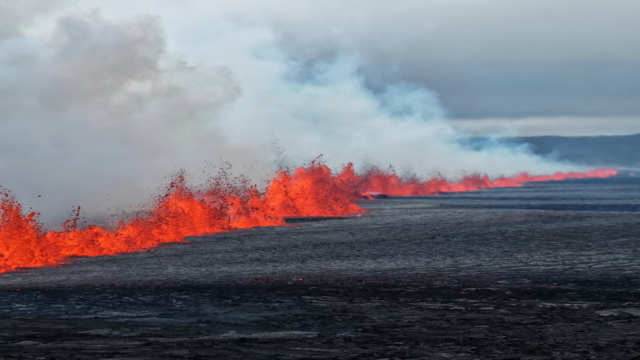
Lava and smoke rise from a crack in the ground near Grindavík, Iceland. Getty Images
A volcano erupted early Wednesday on Iceland’s Reykjanes peninsula. This marks the ninth eruption in the area since late 2023. The Icelandic weather office said the eruption started just before 4 a.m. local time.
Live footage showed glowing lava shooting from a long crack in the ground. Experts measured the main crack at around 2.4 kilometers. A second, smaller one opened nearby and stretched about 500 meters.
Safety Measures in Place
Officials asked people nearby to stay indoors. Dangerous gases from the lava made the air unsafe to breathe. Authorities evacuated the fishing town of Grindavík as a safety step. The popular Blue Lagoon spa also closed, and visitors had to leave.
Around 100 people were evacuated without any problems. Police also stopped tourists from going near the eruption site. They warned that it might look exciting but could be very risky.
“We understand the interest,” said police commissioner Margrét Kristín Pálsdóttir, “but it’s important to stay safe.”
Tourists Watch from a Distance
Some tourists watched the lava flow from a safe distance near the airport in Keflavík. Roads around the volcano remained open, but officials advised people to keep away.
Geophysicist Benedikt Ófeigsson said this eruption seemed smaller than earlier ones. He added that it did not threaten any buildings or important sites.
A Surprise Eruption
Experts had expected no more eruptions in the region until autumn. Just one day before the eruption, a risk report showed a low chance of activity.
Grindavík, once home to about 4,000 people, has faced serious changes. After the first eruption in 2023, the government evacuated most residents. Many of the town’s homes were later sold to the state, and people moved away.
A New Era of Volcanic Activity
Before 2021, this region had been quiet for about 800 years. But that changed in March 2021 when increased earthquakes signaled new volcanic activity.
Experts believe the Reykjanes area may now be in a new volcanic phase. Since then, eruptions have become more frequent.
No Flight Disruptions Expected
Thankfully, the latest eruption isn’t affecting international flights. Planes continue to arrive and depart as usual.
This is important, especially after the 2010 eruption in another part of Iceland. That event sent ash clouds into the air and caused major flight delays around the world.
Iceland has 33 active volcano systems, the most in Europe. The country sits on a boundary between two tectonic plates, making eruptions more common.