

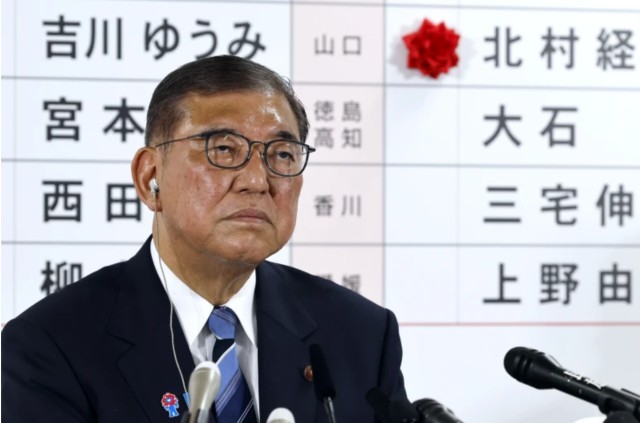
Shigeru Ishiba, Japan’s Prime Minister and president of the ruling Liberal Democratic Party (LDP), meets the media at the LDP headquarters in Tokyo, Sunday, July 20, 2025.
In a critical upper house election, Japanese Prime Minister Shigeru Ishiba’s ruling coalition has lost its majority, delivering a major setback to his leadership. With the country already grappling with rising living costs and pressure from U.S. tariffs, the election results have further rattled Japan’s political landscape.
Ruling Coalition Falls Short of Majority
Ishiba’s Liberal Democratic Party (LDP) and its junior partner Komeito needed 50 additional seats to maintain control in the 248-member upper house. They secured only 47, leaving them three short and losing 19 seats compared to their previous standing.
This marks a historic moment—the first time since the LDP’s formation in 1955 that it no longer holds a majority in both chambers of parliament. The coalition had already lost its majority in the lower house during the October elections.
Ishiba Refuses to Step Down
Despite the defeat, Prime Minister Ishiba has shown no sign of resigning. Instead, he reaffirmed his commitment to lead the government and address economic challenges.
“I will fulfill my responsibility as head of the No. 1 party and work for the country,” Ishiba stated during a live interview on NHK.
He acknowledged the tough situation and admitted that his administration’s inflation relief efforts hadn’t reached the general public effectively.
Exit Polls Predicted a Slide
Ishiba had modest expectations going into the election, aiming for a simple majority of 125 seats overall. Exit polls, however, quickly signalled bad news for the coalition.
The LDP alone managed to win 39 seats—exceeding exit poll projections—but not enough to change the final outcome. Despite remaining the largest party in the Diet, the poor showing highlighted growing public dissatisfaction.
Economic Struggles Fuel Voter Frustration
The election took place amid widespread economic discontent. Voters are grappling with soaring prices, stagnant wages, and increasing social security burdens.
Public anger has intensified as Ishiba’s government has failed to deliver timely relief. Even the price of rice—Japan’s staple food—has been rising steadily.
Stricter immigration rules and a perceived lack of inclusiveness further contributed to voter frustration.
U.S. Tariff Pressure Builds
Internationally, Ishiba faces additional pressure. U.S. President Donald Trump has criticized Japan for slow progress in trade talks.
The U.S. has expressed concern over low Japanese imports of American rice and cars, even as Japan faces grain shortages. A 25% tariff on Japanese goods, set to take effect on August 1, has only added to the strain.
Populist and Conservative Parties Surge
As the ruling coalition stumbles, populist and conservative parties are gaining ground. The far-right Sanseito party made major strides, increasing its seats from one to 14. Its platform includes strict anti-foreigner policies, traditionalist values, and skepticism of vaccines and globalization.
The conservative Democratic Party for the People (DPP) also grew significantly, securing 17 seats, up from just four. Meanwhile, the more centrist Constitutional Democratic Party of Japan (CDPJ) saw little momentum.
Despite their gains, opposition parties remain fragmented and unable to form a unified front.
No Easy Path to a New Coalition
With the ruling coalition now in the minority, governing will become more difficult. Ishiba may try to woo other conservative parties into a coalition, but the opposition has so far rejected any such alliances.
CDPJ leader Yoshihiko Noda made it clear: “Public opinion clearly said ‘no’ to the Ishiba government.”
Voters Divided Between Stability and Change
The election revealed a deep division among voters. Some remain loyal to the LDP for its track record of postwar stability. Others are leaning toward parties promising inclusivity, diversity, and reform.
Tokyo resident Yuko Tsuji said she voted for LDP to maintain unity: “If the ruling party doesn’t govern properly, the conservative base will drift toward extremes.”
On the other hand, self-employed Daiichi Nasu chose the CDPJ for its progressive stance. “I want to see more open immigration and gender equality,” he said.













