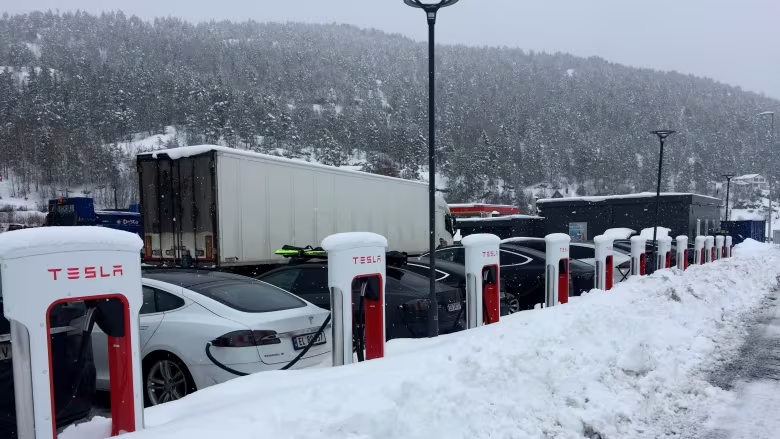
In 2019, Tesla charging stations in Gulsvik, Norway, showcased electric cars. Norway has witnessed a swift increase in electric vehicle sales over the last ten years, marking a notable trend. (Terje Solsvik/Reuters)
In the pursuit of phasing out gasoline and diesel cars by 2035, Canada looks to Norway for inspiration, where electric vehicles (EVs) represent an impressive 82% of total car sales in 2023. Norway aims to cease the sale of traditional vehicles even earlier, by 2025, making it a global leader in EV adoption.
Norway's success story, however, is not an overnight achievement. A decade ago, the country implemented strategic policies to boost EV sales and reduce greenhouse gas emissions. Waiving import duties, registration and sales taxes for EVs, and offering perks like toll exemptions and bus lane access, made electric cars an attractive choice. The high taxes on gasoline vehicles played a pivotal role in steering consumers toward EVs.
Unlike Norway's approach, Canada's 2035 target focuses on compelling car manufacturers to increase EV availability. Federal and provincial rebates are offered, but there is no tax on gasoline vehicles. Experts emphasize the need for Canada to consider emulating Norway's successful policy framework.
Norway's robust charging infrastructure, comprising nearly 8,000 fast-charging stations, supports its EV success. Private investments, spurred by initial government incentives, have played a crucial role. Recommendations are made for Canada to encourage home-based charging solutions, minimizing dependence on public charging stations.
Concerns about grid capacity have arisen, but current data shows that EV demand constitutes only about one percent of Norway's total grid demand. The country's advantage lies in its well-established hydroelectric power grid. Policy choices, such as peak-hour pricing, are suggested to address potential challenges in grid load.
In cold weather, which both Norway and Canada experience, EVs face reduced range. Norway mitigates this with consumer education on preheating vehicles and charging frequency. Lessons learned in Norway can guide Canadians in navigating extreme weather conditions for EVs.
Despite its achievements, Norway's EV policies have faced criticism for favoring the affluent and prioritizing EVs over public transit. However, the country acknowledges the necessity of cars in rural areas while emphasizing the importance of funding public transit, particularly in urban centers.
From an emissions perspective, Norway's transition has been a triumph, with a 15% reduction in road traffic carbon emissions from 2015 to 2021. The focus now shifts towards electrifying transport trucks, indicating a broader commitment to zero-emission solutions.
In summary, Norway's decade-long journey to an EV-dominated market provides valuable insights for Canada as it pursues its 2035 gasoline and diesel car ban. Emphasis on policy consistency, charging infrastructure, grid management, consumer education, and a balanced approach to public transit are key takeaways from Norway's electric vehicle success.