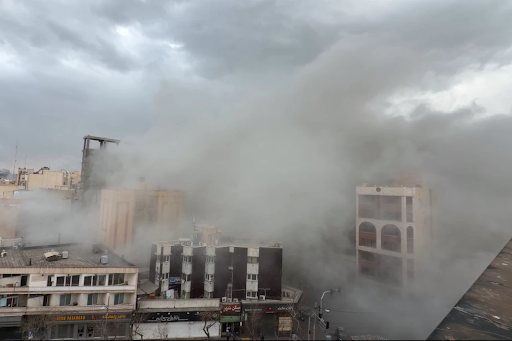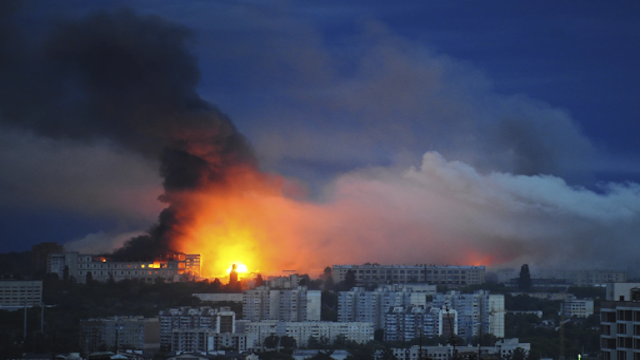
Fire and smoke rise from the site where a Russian missile struck a residential area in Kharkiv, Ukraine, Saturday, June 7, 2025. Associated Press
A deadly Russian missile strike hit a Ukrainian army training center, killing three soldiers and injuring 18 others. The attack targeted a critical facility near Honcharivske in Ukraine’s northern Chernihiv region. This location is a key part of Ukraine’s effort to address its severe troop shortage amid the ongoing war with Russia.
The Russian Defense Ministry claimed the casualties were much higher. According to their report, around 200 Ukrainian personnel were either killed or wounded. The attack used two Iskander missiles—one loaded with multiple submunitions and the other carrying high explosives.
Ukrainian Army Struggles Amid Ongoing Russian Assault
Ukraine’s military confirmed the strike but disputed Russia’s casualty figures. A video released by Moscow showed numerous small explosions followed by a larger blast, likely from the second missile.
This is not the first time such a strike has occurred. Last September, a similar attack on a military academy and nearby hospital killed over 50 people. More than 200 were injured in that incident.
Ukraine's Military Law Enforcement Service has launched an investigation. Authorities aim to determine if negligence or misconduct played a role in the latest casualties.
This is the fourth major strike on military facilities in just five months. Earlier attacks have already claimed the lives of at least 46 Ukrainian soldiers and wounded more than 160 others.
Russia Targets Ukraine’s Recruitment Network
Moscow appears to be focusing on weakening Ukraine’s military infrastructure and recruitment channels. On Wednesday, Russian forces bombed a regional military administration building in the northern Sumy region. A 75-year-old woman was injured. That same building was targeted with drones twice last week.
These attacks are part of a broader Russian campaign to disrupt Ukraine’s already strained mobilization efforts.
Civilian Casualties on the Rise
While military targets continue to be hit, civilian suffering is also escalating. The U.N. reports a disturbing increase in civilian casualties in 2025. Over 6,750 people were killed or injured in the first half of the year alone. This marks a 54% rise from the same period in 2024.
Since the full-scale invasion began in February 2022, more than 13,500 Ukrainian civilians, including 716 children, have lost their lives.
The uptick in drone and missile strikes is a major factor. On the night of the recent attack, Russia launched 78 drones into Ukrainian territory. Ukraine’s air force reported that at least five civilians were injured, and among the drones were newly introduced jet-powered models.
Ukraine’s Growing Manpower Crisis
Despite having over a million personnel in uniform, Ukraine is facing a serious shortage of combat-ready troops. Many units are overstretched, and reports of soldiers going AWOL have increased.
The government is trying new methods to fill the gap. On Tuesday, President Volodymyr Zelenskyy signed a law allowing men over 60 to join the military voluntarily. These recruits will primarily serve in support or technical roles.
Earlier this year, the Defense Ministry launched new incentives to attract volunteers aged 18 to 24. Though not subject to the draft, these men are being encouraged to join the fight.
Ukraine also lowered its conscription age from 27 to 25. However, these changes have so far failed to replace battlefield losses or strengthen depleted units.
Pressure Mounts for Peace Amid Escalation
International pressure for peace is intensifying. U.S. President Donald Trump recently set a new deadline for Russia. He warned that if no progress is made by August 8, harsher U.S. sanctions and tariffs will follow.
Western leaders accuse Russian President Vladimir Putin of prolonging the war in hopes of seizing more territory before peace talks gain traction.
With Russian strikes becoming deadlier and Ukrainian resources stretched thin, the urgency for a resolution is greater than ever.