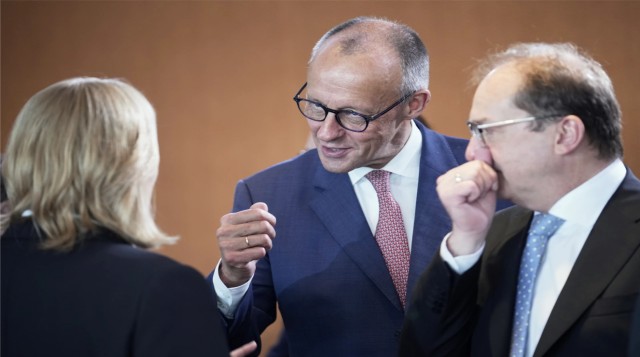
German Chancellor Friedrich Merz, center, attends a cabinet meeting at the chancellery in Berlin, Germany, Wednesday, July 30, 2025.
Ukrainian President Volodymyr Zelenskyy has dismissed Russian President Vladimir Putin’s latest ceasefire proposal. Putin reportedly wants Ukraine to abandon the last 30% of Donetsk still under Kyiv’s control. Zelenskyy called the idea unconstitutional and dangerous, warning it would only pave the way for another Russian attack.
He stressed that Ukraine would not surrender territory seized illegally. Such concessions, he said, would repeat the mistake of 2014, when Russia annexed Crimea.
The proposed deal emerged during talks involving U.S. officials ahead of a high-stakes summit between U.S. President Donald Trump and Putin.
The Ceasefire Proposal
According to Zelenskyy, Russia’s plan includes taking 9,000 square kilometers of Donetsk still held by Ukraine. This area is currently the scene of the war’s fiercest battles. Handing it over would give Moscow control of almost the entire Donbas, Ukraine’s industrial heartland.
Zelenskyy learned about Russia’s position after speaking with Trump and U.S. special envoy Steve Witkoff. Witkoff had met Putin and told Zelenskyy that “territorial concessions” would be needed from both sides.
The Ukrainian leader said he never heard Washington directly demand Ukraine’s withdrawal. Instead, the suggestion came across as Putin’s expectation.
Ukraine Rules Out Withdrawal
Zelenskyy firmly rejected the idea of leaving Donbas. He stressed that Russia’s occupation was illegal and that Donbas could serve as a springboard for future offensives.
“Donbas for the Russians is a springboard for a new offensive,” Zelenskyy warned. He argued that without strong security guarantees, any ceasefire would simply allow Russia to regroup and strike again.
Currently, U.S.-led diplomatic talks are not addressing such guarantees. Europe’s participation is also missing, despite being one of Kyiv’s key demands.
Europe Left Out of Key Talks
The upcoming summit between Trump and Putin has sidelined European leaders. The EU has urged Washington to protect European security interests and to ensure Ukraine’s voice is heard.
EU leaders released a joint statement declaring that “the path to peace in Ukraine cannot be decided without Ukraine.” They also insisted that international borders must not be changed by force.
However, Hungarian Prime Minister Viktor Orbán refused to sign the statement, highlighting divisions within the bloc.
U.S. Strategy Raises Concerns
Trump has indicated that Ukraine might have to give up some territory. He also mentioned the possibility of land swaps, though it is unclear what Moscow might concede.
Analysts warn that Putin could use the summit to secure recognition of Russian control over parts of Ukraine and push for easing sanctions.
Nigel Gould-Davies of the International Institute for Strategic Studies called this a “profoundly alarming moment for Europe.” He warned that any deal favoring Russia would fracture the transatlantic alliance and embolden future aggression.
Russia’s Advance Toward Pokrovsk
While talks unfold, the battlefield situation remains tense. Russian forces are closing in on Pokrovsk, a strategic city in Donetsk.
Military analysts say the next two days could be decisive. Losing Pokrovsk would weaken Ukraine’s supply lines and hand Russia a symbolic victory ahead of the summit.
Ukrainian military reports describe the situation as “difficult, unpleasant and dynamic.” Troops are resisting Russian infantry trying to break defensive lines.
Missile Attack Adds to Tensions
Elsewhere, a Russian missile struck a Ukrainian military training facility. One soldier died, and eleven others were injured.
The attack underscored the ongoing intensity of the conflict, even as international leaders debate a possible ceasefire.
A Battle for Ukraine’s Future
For Zelenskyy, the stakes are clear. Accepting Putin’s demands would hand Russia a near-total victory in Donbas and invite future invasions.
Ukraine insists that any peace must come with security guarantees, European involvement, and respect for its sovereignty. Without these conditions, Kyiv sees no reason to compromise.