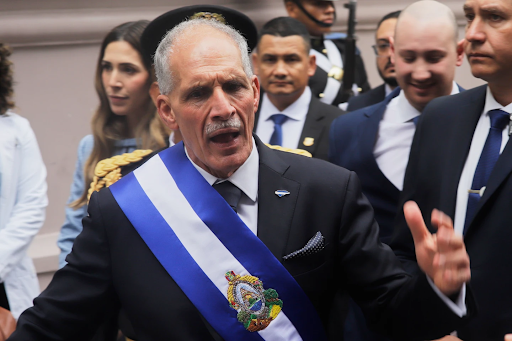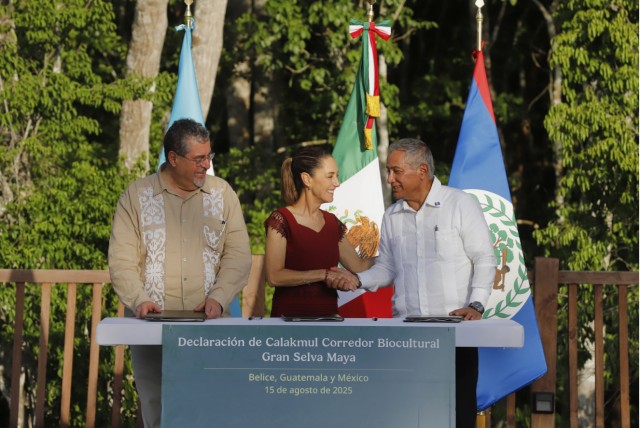
Guatemalan president Bernardo Arévalo looks on while Mexican President Claudia Sheinbaum shakes hands with Belize Prime Minister Minister Johnny Briceño, in Calakmul, Campeche state, Mexico, Friday, Aug. 15, 2025.
The governments of Mexico, Guatemala, and Belize have joined forces to protect one of the world’s most vital ecosystems. On Friday, the three leaders announced the creation of a tri-national nature reserve dedicated to preserving the Mayan jungle.
The reserve will span more than 14 million acres of lush rainforest across southern Mexico and northern Guatemala and Belize. Officials say it will become Latin America’s second-largest protected area, following only the Amazon.
Mexican President Claudia Sheinbaum called the agreement “historic” and said it would safeguard biodiversity, cultural heritage, and future generations.
A New Stronghold for the Mayan Jungle
The Mayan jungle is often described as the “lungs of the Earth.” It shelters thousands of species and communities that rely on its resources.
“This is a living space we must protect,” Sheinbaum said while standing beside Guatemalan President Bernardo Arévalo and Belize Prime Minister Johnny Briceño.
Environmentalists welcomed the announcement, with groups like Selvame praising the move as “a monumental step for conservation.” Still, they warned that the reserve must go beyond symbolism and include strong enforcement against deforestation and development threats.
Environmental Groups Call for Action
The announcement comes at a critical time. Rapid urbanization, real estate expansion, and construction projects are placing intense pressure on the Mayan jungle.
Selvame cautioned that industries are polluting ecosystems and threatening both water supplies and local communities. The group urged Sheinbaum’s government to set up strict monitoring systems and halt destructive activities before it’s too late.
“We’re in a race against the clock,” the organization warned in its statement.
The Shadow of the Maya Train Project
While the reserve brings hope, concerns remain over Mexico’s controversial Maya Train project. The railway, designed to connect tourist hubs with remote archaeological sites, has faced backlash for damaging fragile ecosystems.
Since its construction began, approximately seven million trees have been cut down. Experts also warn that the project has harmed underground cave systems, which serve as the region’s main water source.
Critics argue that the railway was fast-tracked without proper environmental studies. Former President Andrés Manuel López Obrador pushed the project aggressively, often ignoring court orders to stop work.
Expansion Plans Stir Debate
Sheinbaum, continuing her predecessor’s vision, has proposed extending the Maya Train into Guatemala and Belize. She insists the expansion would bring economic development to rural communities.
But not everyone agrees. Guatemala’s President Arévalo has already declared that the train will not pass through his country’s protected jungle areas.
“We share the vision of connecting the Maya Train,” he said, “but it must not come at the cost of environmental destruction.”
Both leaders discussed alternative routes that could loop around sensitive ecosystems instead of cutting directly through them. Belize is also reviewing options carefully, balancing development with conservation.
Balancing Growth and Protection
The creation of the Mayan jungle reserve represents a turning point for environmental cooperation in Latin America. Yet, uncertainty remains over how it will coexist with large-scale projects like the Maya Train.
Arévalo emphasized the need for detailed environmental studies before moving forward with any expansion. Briceño expressed similar caution, calling for development that respects both people and nature.
For now, the tri-national reserve marks a rare moment of unity. It highlights the growing recognition that protecting natural heritage is not only a cultural duty but also a survival necessity.
As the Mayan jungle faces mounting threats, the coming years will reveal whether promises of protection can withstand the pressures of progress.