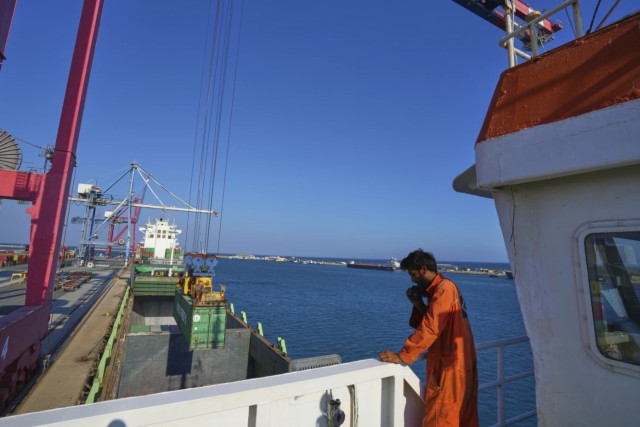
Jalal Uddin, electrical and technology officer abroad a Panamanian-flagged ship watches as containers filled with humanitarian aid for the people of gaza are being loaded abroad the vessel at Cyprus's main port in Limassol, on Monday, Aug 18, 2025.
A ship carrying over a thousand tons of food aid for Gaza was nearing Israel’s Ashdod port on Tuesday. The vessel left Cyprus on Monday in a renewed international effort to fight rising hunger in the war-torn Palestinian territory.
The aid is expected to offer some relief to Gaza’s population as famine risks grow.
1,200 Tons of Food on Board
The Panamanian-flagged ship is carrying 52 containers filled with basic food supplies. Items include rice, pasta, baby food, and canned goods. Israeli customs screened the cargo at Cyprus’ Limassol port before departure.
Of the total, 700 tons were purchased in Cyprus using funds donated by the United Arab Emirates. The support came through the Amalthea Fund, launched last year to help finance seaborne aid.
The rest of the shipment includes contributions from Italy, Malta, a Catholic religious order, and Kuwait’s Al Salam Association.
Cyprus Plays a Key Role
Cyprus has emerged as a hub for aid shipments to Gaza. Last year, it coordinated deliveries of 22,000 tons of supplies through a pier managed by the charity World Central Kitchen (WCK) and a U.S. military docking facility.
However, the mission ended in July 2024 after security issues and poor weather hampered operations.
Cyprus Foreign Minister Constantinos Kombos described the current mission as urgent. “The situation is beyond dire,” he said, stressing the importance of international cooperation.
U.N. to Oversee Distribution
The United Nations is leading the new operation. Once the food reaches Ashdod, U.N. workers will arrange trucks to move it into Gaza. Supplies will be stored in warehouses and distributed through food stations run by World Central Kitchen.
The charity, trusted widely in Gaza, handled the first sea delivery last year. Kombos praised the effort, saying, “The contribution of everyone involved is crucial and their commitment incredible.”
Sea Routes Offer Bigger Relief
Shipments by sea can deliver far larger amounts of aid than recent airdrops by several nations. Aid workers emphasize that such bulk deliveries are vital as Gaza’s food crisis worsens.
The latest mission also comes at a politically sensitive moment. Hamas announced it had accepted a new ceasefire proposal mediated by Arab nations. Israel has yet to approve it.
War and Famine Threats Intensify
Talks over a truce collapsed last month. Israel responded by announcing plans to reoccupy Gaza City and other dense urban areas. This raised fears of a deeper humanitarian disaster.
Israeli Prime Minister Benjamin Netanyahu has rejected claims of famine. He described them as “lies” spread by Hamas.
But the United Nations paints a grim picture. It warned last week that starvation and malnutrition in Gaza are at their worst levels since the conflict erupted.
Rising Death Toll in Gaza
The war began on October 7, 2023, when Hamas attacked southern Israel. Militants killed around 1,200 people, mostly civilians, and abducted 251 others.
Since then, Gaza’s Health Ministry says more than 62,000 Palestinians have died during 22 months of fighting. The ministry does not specify how many were civilians or fighters, but reports that women and children make up nearly half of the casualties.
A Race Against Time
For many in Gaza, the new shipment represents more than food—it offers a chance of survival. With famine looming, international aid groups warn that larger, regular deliveries are the only way to prevent disaster.
The success of this mission could determine how future aid is organized for Gaza’s hungry population.