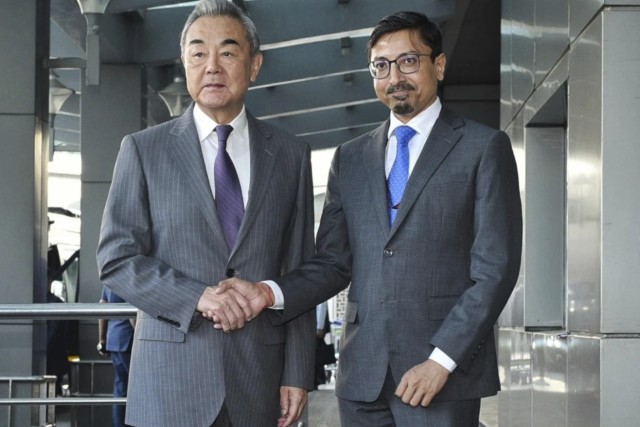
Chinese Foreign Minister Wang Yi, left, is welcomed by an unidentified Indian foreign ministry official upon his arrival at the airport in New Delhi, India, Monday, Aug. 18, 2025.
The foreign ministers of India and China held crucial talks in New Delhi on Monday. The meeting marks a new attempt by the Asian neighbors to reduce long-standing tensions at their disputed border.
Indian Foreign Minister Subrahmanyam Jaishankar welcomed his Chinese counterpart, Wang Yi, for discussions aimed at stabilizing ties. Relations between the two countries soured sharply in 2020 after deadly clashes in the Himalayan region. That confrontation claimed the lives of 20 Indian soldiers and four Chinese troops, the worst violence in decades.
A Push to Normalize Ties
Since the clash, both countries deployed tens of thousands of soldiers along the contested frontier. Military build-up created a prolonged standoff and pushed diplomatic ties to their lowest point in years.
Efforts at resolution began last year when both sides agreed to withdraw additional troops from sensitive areas. They also reached a pact on managing patrols to avoid further conflict. Monday’s talks were seen as a continuation of this gradual thaw.
Jaishankar Stresses De-escalation
Opening the dialogue, Jaishankar underlined the importance of reducing tensions along the border. He noted that normalization of relations can only come from trust and stability.
“Having seen a difficult period in our relationship, our two nations now seek to move ahead. This requires a candid and constructive approach from both sides,” Jaishankar stated.
His remarks reflected India’s call for concrete steps from China to restore confidence and rebuild political ties.
Wang Yi Highlights Positive Signs
Chinese Foreign Minister Wang Yi echoed the need for cooperation. He pointed out that peace has largely prevailed at the border in recent months.
He also noted that China has facilitated Indian pilgrimages to sacred sites in Tibet, calling it a gesture of goodwill. Wang’s comments suggested Beijing’s readiness to explore practical steps for easing friction.
Key Meetings Ahead
Wang’s visit will continue with high-level engagements in New Delhi. On Tuesday, he is scheduled to meet Prime Minister Narendra Modi and National Security Adviser Ajit Doval.
Talks with Doval are expected to focus on reducing troop numbers along the Himalayan frontier. Security analysts believe these discussions could set the stage for broader confidence-building measures.
Wider Diplomatic Context
The timing of Wang Yi’s trip is significant. It comes as India faces trade tensions with the United States. Washington recently announced a 50% tariff on Indian goods. The new measures also include a 25% penalty linked to India’s purchase of Russian crude oil.
The tariffs, set to take effect on August 27, are seen as a challenge for New Delhi. Analysts say the U.S. decision adds pressure on India’s economic diplomacy while it manages delicate relations with China.
A Cautious Path Forward
The New Delhi talks signal a cautious step toward reconciliation between India and China. Both sides acknowledge the need for dialogue after years of distrust.
Yet, the path forward remains uncertain. Deep differences over the Himalayan border continue to test the relationship. The outcome of Wang Yi’s meetings with Modi and Doval will be closely watched.
For now, the discussions highlight an important reality: dialogue remains the only bridge across the divide between Asia’s two largest neighbors.