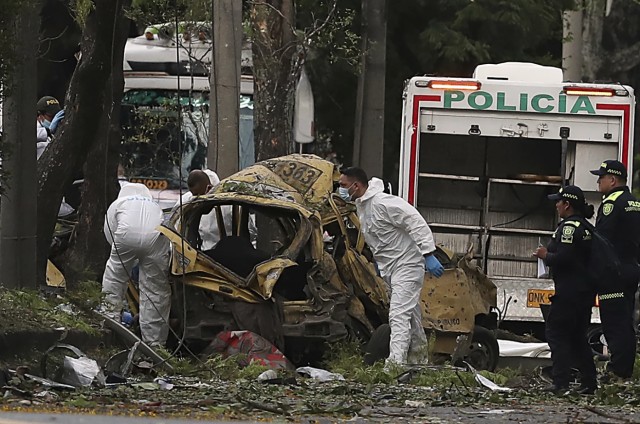
Forensics inspect the site of a bomb explosion outside an airforce base in Cali, Columbia, Thursday, August 21, 2025.
At least 17 people, including police officers, lost their lives in two separate attacks in Colombia on Thursday. Authorities confirmed a car bomb explosion and an assault on a police helicopter. President Gustavo Petro linked both attacks to dissidents of the Revolutionary Armed Forces of Colombia (FARC), a guerrilla group officially disbanded in 2016.
Deadly Strike on Police Helicopter
The most devastating incident occurred in Antioquia, northern Colombia. A police helicopter carrying officers on an anti-narcotics mission was targeted. Officials reported that the aircraft was transporting personnel tasked with eradicating coca leaf crops, the raw material for cocaine.
At least 12 police officers were killed in the attack. President Petro initially reported eight casualties, but Antioquia Governor Andrés Julián later confirmed four additional deaths. Three officers remain hospitalized with injuries.
The governor said on X (formerly Twitter) that a drone was used to attack the helicopter as it flew over coca fields. Colombia’s Defense Minister Pedro Sánchez noted that preliminary reports suggest the strike triggered a fire onboard, leading to the deadly crash.
Car Bomb Explosion in Cali
Just hours later, a car bomb detonated in Cali, southwestern Colombia. The explosion occurred near a military aviation school, claiming five lives and injuring more than 30 people. Authorities reported that the vehicle was packed with explosives.
The Colombian Air Force has not released detailed information about the blast. Emergency teams quickly responded to the scene, transporting the injured to nearby hospitals.
Who Is Behind the Attacks?
President Petro first pointed to the Gulf Clan, Colombia’s most powerful drug cartel, as the group behind the helicopter strike. He suggested the assault was retaliation for a recent cocaine seizure that allegedly belonged to the cartel.
However, Petro later connected the incidents to FARC dissidents. He confirmed that one alleged member of the group was arrested near the explosion site.
Both FARC dissidents and Gulf Clan operatives are active in Antioquia, making the situation more complex. Security agencies are now investigating whether the groups acted together or separately.
Coca Cultivation at Record Highs
The attacks underline Colombia’s ongoing struggle with narcotics production and armed groups. Coca cultivation, despite years of government eradication efforts, is increasing.
According to the U.N. Office on Drugs and Crime, coca cultivation in Colombia reached a record 253,000 hectares in 2023. The surge in cultivation has fueled tensions between authorities and armed groups that profit from the cocaine trade.
Rising Security Concerns
The dual attacks highlight the fragile security environment in Colombia. FARC dissidents, who rejected the 2016 peace deal, continue to launch violent assaults against government forces. Meanwhile, drug cartels like the Gulf Clan remain heavily armed and entrenched in key regions.
President Petro vowed stronger action against those responsible. “These attacks show the depth of criminal power in our territories,” he stated. Authorities are reinforcing security in Antioquia and Cali, fearing further violence.
Colombia’s Path Ahead
The violence once again raises questions about peace and stability in Colombia. Despite past peace accords, dissident factions and drug cartels still challenge state authority. Communities living in coca-growing regions remain at the center of this conflict.
With record-high coca cultivation and rising attacks on security forces, Colombia faces a tough battle. Restoring peace will require both military strength and long-term strategies to reduce the influence of armed groups.