Armenians offered mixed reactions to a U.S.-brokered deal signed Friday at the White House, where Azerbaijani President Ilham Aliyev and Armenian Prime Minister Nikol Pashinyan agreed to end decades of conflict and reopen key transportation routes.
Residents and politicians in Armenia and Azerbaijan are reacting with both optimism and caution to a new U.S.-brokered peace agreement signed at the White House. The deal, aimed at ending decades of hostility, has stirred hope for peace but also raised questions about its long-term impact.
A Handshake in Washington
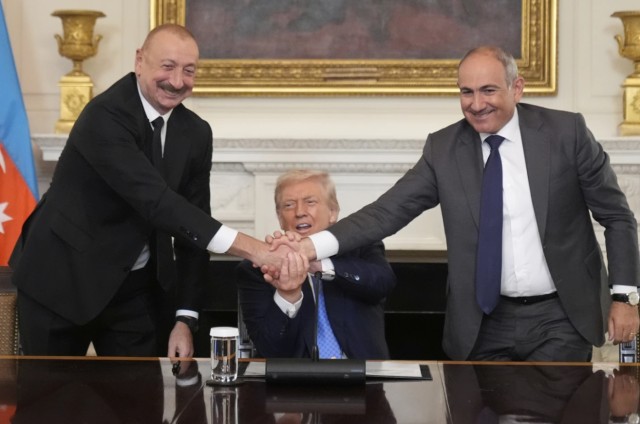
On Friday, Azerbaijani President Ilham Aliyev and Armenian Prime Minister Nikol Pashinyan signed the agreement in the presence of U.S. President Donald Trump. The two leaders shook hands as Trump clasped both their hands together, symbolizing a possible new era for the South Caucasus.
While not a formal peace treaty, the deal is seen as a significant milestone. It comes after Azerbaijan’s 2023 military victory, which forced Armenian forces and ethnic Armenians to leave Nagorno-Karabakh, a territory internationally recognized as part of Azerbaijan but contested for decades.
The “Trump Route” and Shifting Power
One of the agreement’s provisions is the creation of a new transit corridor, referred to as the “Trump Route for International Peace and Prosperity.” This corridor underlines changing geopolitical realities, particularly as Russian influence in the region declines.
Nagorno-Karabakh has been the core of the Armenia-Azerbaijan conflict since the collapse of the Soviet Union. The region has witnessed two major wars, in the early 1990s and again in 2020, leaving tens of thousands dead and displacing many more. Azerbaijan’s swift 2023 offensive returned full control of the territory to Baku.
A Blow to Russian Influence
In Azerbaijan, opposition leaders noted the broader implications of the agreement.
Ali Karimli, head of the People’s Front Party, called the deal a “significant step closer to peace” and said it weakened Moscow’s role in the South Caucasus while strengthening ties with the United States.
Arif Hajili, leader of the Musavat Party, welcomed Washington’s role and stressed that the “most positive aspect” of the talks was Russia’s absence. He added that lasting peace depends on the outcome of the Russia-Ukraine war and warned that Moscow could still leverage Armenia’s economic reliance and the presence of nearly two million Azerbaijanis in Russia.
Voices of Hope in Baku
On the streets of Baku, many welcomed the breakthrough.
“We’ve been waiting for this agreement for years,” said Gunduz Aliyev. “Russia couldn’t guarantee peace, but the U.S. has stepped in.”
Another resident, Ali Mammadov, expressed optimism. “The U.S. is now a guarantor of security. Borders will open, and normal ties with Armenia will follow.”
Abulfat Jafarov echoed these sentiments: “Peace is always good. We welcome every step towards progress.”
Mixed Feelings in Yerevan
In Armenia’s capital, Yerevan, reactions were more divided. Some welcomed possible economic benefits, while others voiced skepticism.
“I feel uncertain. Many aspects are unclear, and more details are needed,” said resident Edvard Avoyan.
Entrepreneur Hrach Ghasumyan highlighted potential opportunities: “If oil pipelines and railway routes pass through Armenia, it could finally open economic doors for us.”
But others were unconvinced. Ruzanna Ghazaryan argued that the agreement favors Azerbaijan: “This declaration is unlikely to bring real peace. The concessions are all one-sided.”
A Fragile Start to Peace
The U.S.-brokered agreement marks a dramatic turn in a conflict that has shaped the South Caucasus for decades. While it represents hope for reconciliation, many remain cautious about its promises.
For Armenians and Azerbaijanis, the future now depends on whether this fragile accord can transform into lasting peace — or whether history will repeat itself.