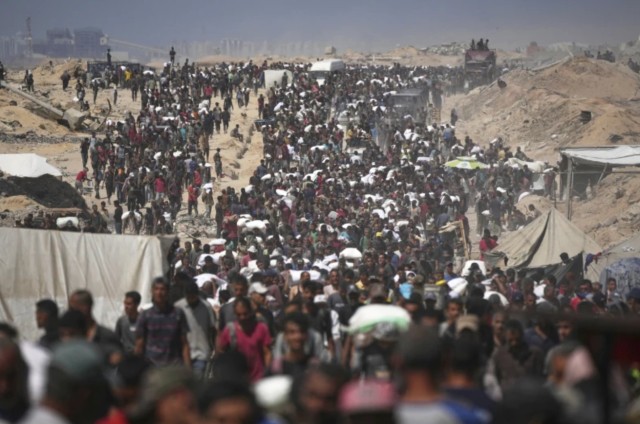
Palestinians carry sacks of flour taken from a humanitarian aid convoy in the outskirts of Beit Lahiya, northern Gaza Strip, Aug. 1, 2025.
For the first time, the world’s top food crisis authority has declared famine in Gaza City. The Integrated Food Security Phase Classification (IPC) confirmed that famine conditions exist in the city and may soon spread to other regions unless urgent action is taken.
The declaration follows months of warnings by humanitarian groups that Israeli restrictions on aid, combined with ongoing military operations, were driving widespread starvation.
Famine Reaches Gaza City
Gaza City, home to hundreds of thousands, is now officially gripped by famine. According to the IPC, the crisis could spread to Deir al-Balah and Khan Younis by next month.
The situation marks the first famine declaration in the Middle East under IPC standards. Analysts warn that continued military offensives in Gaza will only worsen hunger and displacement.
A Humanitarian Disaster Unfolding
Over 500,000 people—nearly a quarter of Gaza’s population—are already facing catastrophic hunger levels. Many are at risk of dying from malnutrition or related diseases.
U.N. Secretary-General António Guterres described the findings as a “human-made disaster” and a “failure of humanity.” He has called for an immediate ceasefire to stop further suffering.

Ahmad Sbeteh, 17, injured by shrapnel from a strike on a neighboring house, has lost about 15 kilograms (33 pounds), and doctors say the lack of healthy food and nutritional supplements is slowing his recovery at Shifa Hospital in Gaza City on Monday, Aug. 18, 2025. Before the shrapnel injury, he had no preexisting conditions, doctors say.
Israel Rejects the Famine Report
Israeli Prime Minister Benjamin Netanyahu dismissed the famine declaration as “an outright lie.” His office insisted Israel does not pursue starvation as a policy.
The Israeli military agency overseeing aid, known as COGAT, also rejected the report as “false and biased,” claiming significant steps have been taken to expand food deliveries.
Israel’s Foreign Ministry said more than 100,000 trucks of aid had entered Gaza since the war began. But aid agencies argue that supplies remain far below what is urgently required.
U.S. and Global Reactions
The U.S. State Department acknowledged Gaza’s humanitarian crisis but questioned the famine findings, blaming Hamas and looters for aid shortages.
Meanwhile, international experts say the blockade between March and May, when all food and medicine were restricted, triggered the sharpest hunger spike.
Chris Newton of the International Crisis Group warned that preventable deaths from starvation and disease are rising rapidly.
How Famine Is Determined
A famine is declared when three conditions are met:
- At least 20% of households suffer extreme food shortages.
- At least 30% of children face acute malnutrition.
- At least two people, or four children under five, die daily from hunger or related diseases.
Recent IPC data shows that Gaza has already crossed these thresholds. The group warns that a third of Gaza’s population could face catastrophic hunger by September.
Families Struggle as Children Waste Away
The famine has left devastating personal stories across Gaza. Doctors report rising numbers of emaciated patients, many too weak to move.
Kirsty Blacka, an emergency nurse, described treating men who looked like teenagers because of severe starvation. Contaminated water, infections, and displacement have worsened the crisis.
Families say they are helpless as their loved ones waste away.
Yousef Sbeteh, a father in Gaza City, says his teenage children, both injured in airstrikes, have lost dramatic amounts of weight in hospital due to lack of nutrition.
“My daughter needs protein, meat, and fish,” he said. “But I can’t provide that now.”
The Urgent Need for Action
Experts argue that earlier famine recognition could have saved lives if Israel had allowed full data collection. Now, with famine officially declared, pressure is mounting on Israel to allow unrestricted aid.
Without an immediate ceasefire and open humanitarian corridors, millions in Gaza remain at risk of hunger, disease, and death.