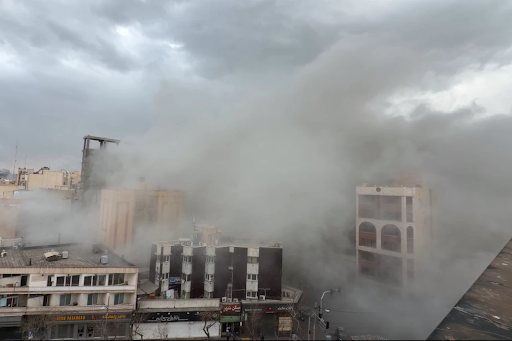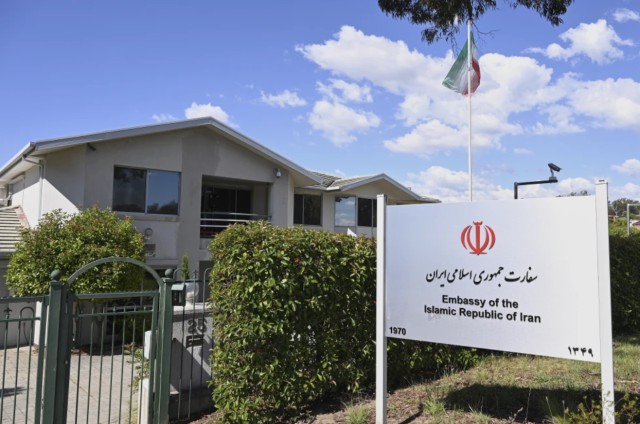
A general view of the Iranian Embassy in Canberra, Australia, Friday, Feb. 10, 2023.
Australia has expelled Iran’s ambassador after intelligence confirmed Tehran’s involvement in antisemitic attacks on Australian soil. Prime Minister Anthony Albanese announced the move, calling the incidents “dangerous acts of aggression.”
The decision followed findings by the Australian Security Intelligence Organization (ASIO), which directly linked Iran’s government to attacks on Jewish sites in Sydney and Melbourne last year.
Attacks Targeted Jewish Businesses and Places of Worship
ASIO concluded that Iran orchestrated at least two antisemitic attacks in 2023.
One targeted the Lewis Continental Kitchen, a kosher food company in Sydney.
The second involved the Addas Israel synagogue in Melbourne.
“These were extraordinary and unacceptable acts of aggression,” Albanese said. “A foreign government sought to undermine Australia’s social cohesion.”
Iran has not yet issued an official response.
Diplomatic Fallout Between Australia and Iran
Shortly before the public announcement, Iran’s Ambassador to Australia, Ahmad Sadeghi, was told to leave.
At the same time, Australia recalled its diplomats from Iran, relocating them to a third country for security reasons.
Albanese stressed that such actions would not be tolerated. He confirmed that Australia will move to designate Iran’s Islamic Revolutionary Guard Corps (IRGC) as a terrorist organization.
Rising Antisemitism Amid Israel-Hamas War
The incidents come against a backdrop of rising antisemitism in Australia.
Since the Israel-Hamas war erupted in 2023, Sydney and Melbourne have recorded sharp increases in antisemitic acts.
Albanese said ASIO uncovered credible intelligence showing Tehran tried to disguise its involvement.
“Iran has sought to hide its hand. But the evidence is clear. Iran directed these attacks,” he told reporters.
Iran’s History of Overseas Operations
Iran’s Revolutionary Guard has long faced accusations of operating beyond its borders.
Western nations claim its elite Quds Force has supported local militants, criminals, and proxy groups to target dissidents and Israelis abroad.
Israel has also accused Iran of funding individuals to carry out vandalism and monitor targets since the Gaza conflict escalated.
Although Tehran often denies these allegations, Western intelligence agencies have repeatedly tied it to covert overseas activities.
Tensions With Israel Add Fuel to the Fire
Australia’s decision to act against Iran follows a diplomatic rift with Israel.
Last week, Israeli Prime Minister Benjamin Netanyahu harshly criticized Albanese, calling him a “weak politician” who betrayed Israel.
The comments came after Australia announced it would formally recognize a Palestinian state at the United Nations General Assembly in September.
This recognition sparked a wave of retaliatory measures, including the cancellation of visas for both Australian and Israeli officials.
Australia’s Strong Message to Foreign Adversaries
Albanese described Iran’s actions as deliberate attempts to sow division in Australian society.
“These acts were designed to create fear, distrust, and discord. We will not allow it,” he said.
The prime minister emphasized that Australia’s response sends a clear message.
“No nation can carry out violent acts in our country without consequences,” he declared.
What Happens Next?
With Iran’s envoy expelled and the IRGC expected to be listed as a terrorist group, relations between Canberra and Tehran face further strain.
Meanwhile, Jewish communities in Australia remain on high alert, as antisemitic threats continue to rise globally.
For now, Australia is tightening its intelligence monitoring and reinforcing its stance against foreign interference.