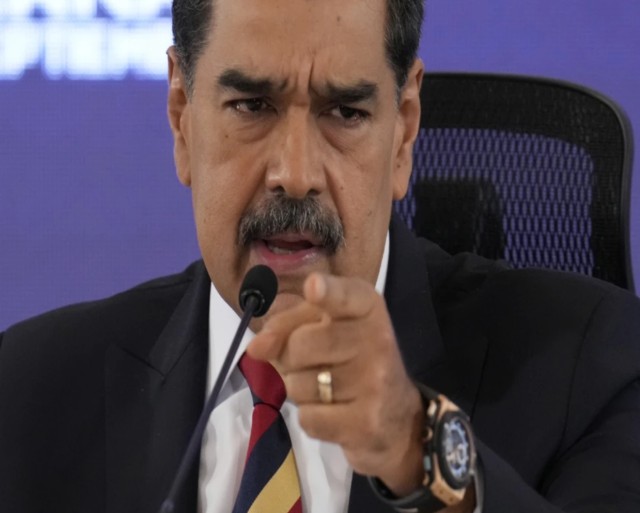
Venezuela President Nicolas Maduro speaks during a press conference in Caracas, Venezuela, Monday, Sept. 1, 2025.
Venezuelan President Nicolás Maduro issued a stern warning on Monday. He said his nation would “constitutionally declare a republic in arms” if U.S. forces stationed in the Caribbean launched an attack on Venezuela.
The statement came during a tense press conference in Caracas, where Maduro denounced Washington’s growing military presence near Venezuelan waters.
U.S. Military Build-Up Near Venezuela
The United States is strengthening its maritime force in the Caribbean. Officials say the move targets Latin American drug cartels accused of funneling fentanyl and other illicit substances into U.S. communities.
Currently, two Aegis guided-missile destroyers — USS Gravely and USS Jason Dunham — are deployed in the Caribbean. They are joined by the destroyer USS Sampson and the cruiser USS Lake Erie patrolling nearby waters.
This presence is expected to grow further. Three amphibious assault ships carrying more than 4,000 sailors and Marines are set to enter the region this week, according to U.S. defense officials.
Venezuela Responds With Troop Deployment
Maduro’s administration reacted swiftly. Troops have been stationed along Venezuela’s coastline and its border with Colombia. Authorities are also encouraging citizens to join the civilian militia in preparation for possible conflict.
“In the face of this maximum military pressure, we have declared maximum preparedness for the defense of Venezuela,” Maduro declared. He described the U.S. deployment as “extravagant, unjustifiable, immoral, and absolutely criminal.”
Venezuela Denounces ‘False Narrative’
Foreign Minister Yván Gil challenged Washington’s justification for the build-up. Citing a U.N. report, he argued that 87% of Colombia’s cocaine exports leave through the Pacific, not Venezuela. Only 5% passes through Venezuelan territory, he said, undermining U.S. claims of combating trafficking.
Gil warned that escalating tensions would “threaten the entire region” and destabilize Latin America. He called on the Community of Latin American and Caribbean States to oppose the U.S. naval deployment, which he described as a direct threat to Venezuelan sovereignty.
Maduro’s Political Struggles
Beyond the military crisis, Maduro also touched on politics. He insisted once again that he was the rightful winner of last year’s contested presidential election. However, international observers and several governments, including the U.S., dispute this claim.
Maduro, who was sworn in for a third six-year term in January, revealed that two channels of communication remain open with Washington — one with the State Department and another with U.S. envoy Richard Grenell.
Yet, he lashed out at Secretary of State Marco Rubio, calling him a “warlord” orchestrating efforts to topple his government.
Opposition Welcomes U.S. Pressure
Meanwhile, Venezuela’s opposition is embracing the American show of force. Opposition leader María Corina Machado recently praised the U.S. deployment, describing it as “the right approach” to confront what she calls a “criminal enterprise” in Caracas.
The opposition has been urging international powers, especially the U.S., to pressure Maduro into stepping down since the disputed July 2024 election.
Maduro’s Direct Warning to Trump
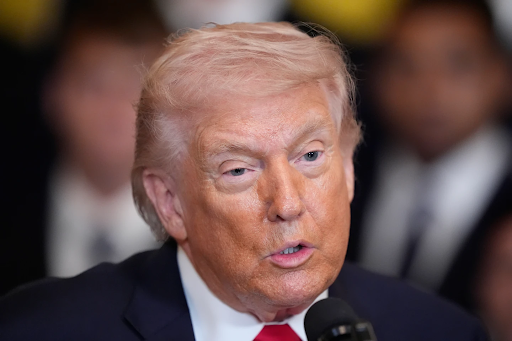
Maduro sent a direct message to former U.S. President Donald Trump, who is driving the deployment strategy. He warned that any military action against Venezuela would “stain Trump’s hands with blood.”
“Regime change as a policy has failed worldwide,” Maduro said. “You cannot pretend to impose a situation in Venezuela.”
The confrontation highlights a dangerous escalation. As U.S. warships gather near Venezuelan waters and Caracas mobilizes troops, the risk of military conflict in the Caribbean looms larger than ever.