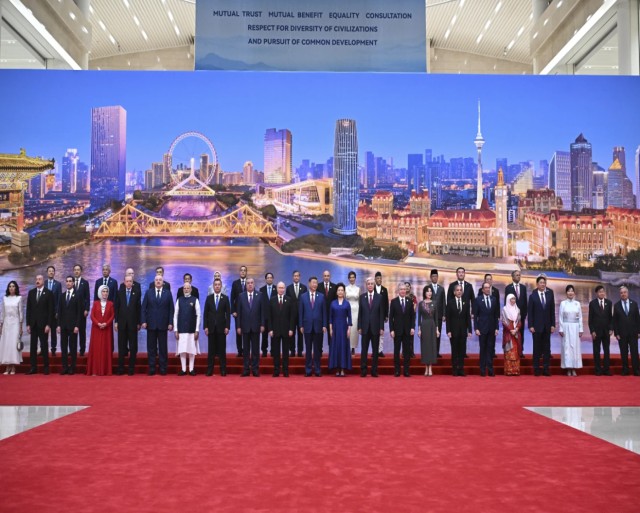
Russian President Vladimir Putin, center left, Chinese President Xi Jinping, center, and his wife Peng Liyuan, center right, pose for a photo with other leaders during a ceremony to welcome Heads of States of the Shanghai Cooperation Organization (SCO) summit in Tianjin, China , on Sunday, Aug. 31, 2025.
Leaders from Russia, China, India, and several other nations gathered in Tianjin, China, for the Shanghai Cooperation Organization (SCO) summit. The meeting brought together 10 member states that collectively represent a growing alternative to U.S. global leadership.
Expanding SCO Membership Strengthens Its Weight
Founded in 2001, the SCO has evolved into a powerful regional bloc. Initially created to counter U.S. influence in Central Asia, it now includes China, Russia, India, Pakistan, Iran, Belarus, and four Central Asian republics—Kazakhstan, Kyrgyzstan, Tajikistan, and Uzbekistan.
India and Pakistan joined in 2017, Iran in 2023, and Belarus in 2024. This expansion has made the SCO one of the world’s largest regional organizations. Yet, questions remain about its effectiveness and unity.
Balancing Relations in a Shifting World
Some SCO members are clear U.S. adversaries, such as Iran and Belarus. Others, like India, walk a fine line between cooperation and caution. China and Russia use the bloc to enhance their regional presence, while India seeks to balance its partnerships with both the East and the West.
Despite differing priorities, the group signals a collective push for multipolarity—reducing reliance on Western-led structures.
China’s Push for a Multipolar World Order
China sees the SCO as a key platform to advance President Xi Jinping’s vision of a multipolar world. Chinese analysts highlight the importance of maintaining international relations and using the SCO to project stability, even if its concrete achievements remain limited.
Political experts suggest the group aims to move beyond being a discussion forum. Beijing hopes it will evolve into a practical cooperation mechanism that produces real benefits for member nations.
Xi Jinping’s leadership at the summit bolsters his global image. Hosting the event allows China to present itself as the driver of an emerging world order.
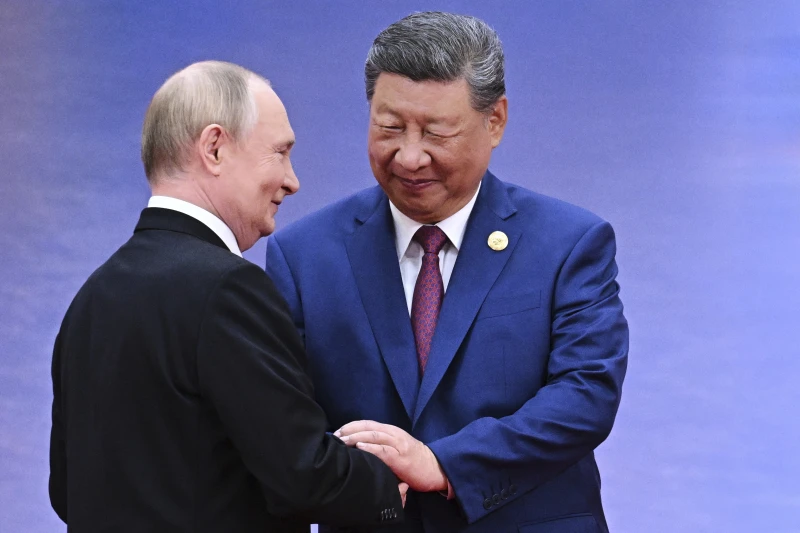
Russian President Vladimir Putin, left, and Chinese President Xi Jinping greet each other at a ceremony to welcome Heads of States of the Shanghai Cooperation Organization (SCO) summit in Tianjin, China, Sunday, Aug. 31, 2025
Russia’s Influence Under Pressure
Russia remains an important player within the SCO, but its influence has declined under Western sanctions and economic isolation. Moscow still relies on the bloc for military cooperation and political backing. However, its reduced financial strength leaves China as the dominant force in shaping SCO strategies.
India’s Role Could Shift the Balance
India’s position within the SCO is complex. It has increased imports of Russian oil since the Ukraine war, drawing U.S. criticism. At the same time, India is cautious about aligning too closely with China and Russia on sensitive global issues.
New Delhi continues to push for a permanent seat at the United Nations Security Council, though it receives lukewarm support from Beijing and Moscow. Within the SCO, India asserts independence, as seen in its refusal to sign a defense ministers’ statement earlier this year due to perceived pro-Pakistan leanings.
India’s growing economic clout and strategic independence could reshape SCO dynamics in the years ahead.
A Showcase of Power and Symbolism
China used the Tianjin summit to highlight growing trade and connectivity projects within the bloc. The meeting was described by state media as the largest SCO summit in history.
Agreements signed during the event included a joint statement on the 80th anniversary of World War II’s end. Many leaders are expected to attend China’s September 3 military parade in Beijing, where North Korean leader Kim Jong Un will make a rare international appearance.
The Road Ahead for the SCO
The Shanghai Cooperation Organization continues to expand its footprint, both politically and economically. While internal differences remain, its very existence signals shifting global power balances.
For China, the SCO reinforces its multipolarity vision. For Russia, it offers a platform to maintain relevance. For India, it provides space to navigate great-power competition.
The question that lingers: can the SCO transform from a symbolic gathering into a force that genuinely challenges U.S. dominance?