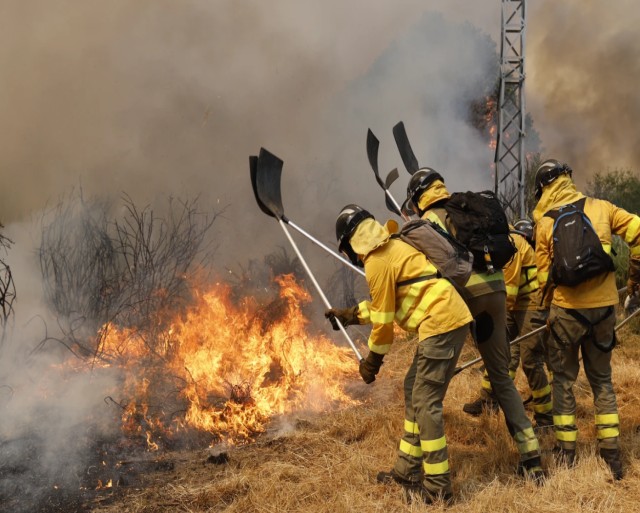
Firefighters battle a wildfire in veiga das meas, northwestern Spain, Saturday, Aug 16, 2025.
The Iberian Peninsula has endured one of its most destructive wildfire seasons in history. Scientists now say climate change played a decisive role. According to a new study, the extreme heat and dryness that fueled the blazes were 40 times more likely because of human-driven warming.
Heat and Dryness Pushed Fires Beyond Control
The wildfires raged across Spain and Portugal during July and August. With temperatures soaring above 40°C (104°F) and fierce winds spreading flames rapidly, the fires devastated vast landscapes.
Eight people lost their lives. More than 35,000 were forced to flee their homes. Nearly 640,000 hectares—two-thirds of Europe’s burned land this year—were reduced to ash. Officials say cooler weather has now helped bring most fires under control.
“Hotter, drier and more flammable conditions are intensifying with climate change,” warned Clair Barnes of Imperial College London. “This is driving fires of unprecedented strength.”
Europe Warming Faster Than Global Average
Europe has warmed at double the global rate since the 1980s, according to the Copernicus Climate Change Service. This acceleration makes the continent more vulnerable to extreme weather.
The World Weather Attribution (WWA) group, which investigates links between climate change and severe weather, confirmed that the Iberian wildfires were no exception. Their findings show that hot, dry, and windy spells that fueled the fires are becoming much more common.
A Rare Event Made Common
Spain experienced its hottest ten-day period on record in August. WWA researchers found that without climate change, such conditions would only happen once every 500 years. Now, they are vastly more likely.
“This study adds to the growing evidence of how human activity is amplifying extreme weather,” said Valérie Masson-Delmotte, a leading climate scientist. “Climate change is making hot and dry fire weather far more frequent and intense.”
Unlike full attribution studies, this analysis relied on weather observations rather than advanced climate models. Still, the results match previous research and align with studies of wildfires in Turkey, Greece, and Cyprus earlier this year. Those fires were found to be 10 times more likely due to climate change.
Human Activity Intensifies Fire Risks
Researchers stressed that climate change is not the only factor. Rural depopulation has left vast areas of farmland and forests unmanaged. Overgrown vegetation now acts as dangerous fuel for wildfires.
“Since the 1970s, rural abandonment has led to fuel build-up,” explained Ricardo Trigo of the University of Lisbon. “Combined with poor forestry practices, it has created conditions ripe for uncontrollable fires.”
Experts recommend reducing risks by clearing vegetation, promoting controlled grazing with livestock, and carrying out prescribed burns. These measures, they say, can limit fire spread during critical summer months.
Governments Under Pressure to Act
In response to the crisis, Spanish Prime Minister Pedro Sánchez unveiled a 10-point plan this week. His proposal focuses on improving disaster preparedness, strengthening forest management, and enhancing cooperation with Portugal and France.
Scientists and policymakers agree on one point: the Mediterranean’s fire-prone climate is becoming more dangerous as global temperatures rise. Without urgent action, extreme wildfires could become the new normal.