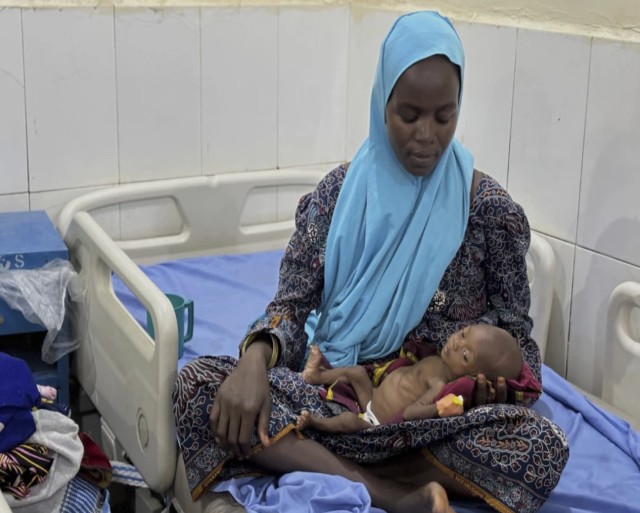
A malnourished child receives treatment at the Intersos facility, an Italian humanitarian organization, the only remaining facility providing in-patient services for malnutrition in Maiduguri, northeastern, Nigeria, May 1, 2025.
The United States has approved $32.5 million in assistance to Nigeria to address a worsening hunger crisis. The decision marks a rare policy shift, as most U.S. foreign aid through the U.S. Agency for International Development (USAID) had been suspended since the Trump administration.
The U.S. mission to Nigeria confirmed the new funding in a statement on Wednesday, noting that the aid will focus on food assistance and nutritional support for displaced people living in conflict-affected areas.
Hunger Crisis Deepens in Northern Nigeria
Northern Nigeria is currently facing what humanitarian agencies describe as “an unprecedented hunger crisis.” Insecurity, violent clashes, and funding cuts have severely worsened the situation. According to the World Food Programme (WFP), more than 1.3 million people could be left without access to food, while around 150 nutrition clinics in Borno State risk shutting down.
Margot van der Velden, WFP’s regional director for West Africa, highlighted the alarming trend in July. She warned that without urgent funding, food shortages would escalate and leave millions vulnerable.
Impact of Global Aid Cuts
The hunger crisis in Nigeria is not isolated. Across West and Central Africa, WFP operations have suffered from drastic funding cuts. In July, the agency suspended food assistance programs in several crisis-hit countries. Food stock projections showed that by September, supplies would be depleted in most affected areas. This left millions of people at risk of losing emergency aid.
Against this backdrop, the U.S. assistance package is expected to provide vital relief in Nigeria’s northeast and northwest regions.
Who Will Benefit from the US Aid?
The U.S. mission stated that the $32.5 million package will directly benefit 764,205 people across Nigeria. The support includes electronic food vouchers and nutritional supplements for vulnerable groups.
Specifically, 41,569 pregnant and breastfeeding women and girls will receive complementary nutrition top-ups. In addition, 43,235 children are expected to benefit from targeted food assistance. These interventions aim to address both immediate hunger and long-term nutritional needs.
Rising Violence Adds Pressure to Food Security
The hunger emergency is compounded by rising violence in Nigeria’s northwest and north-central regions. Increasing attacks on rural communities have disrupted farming and worsened access to land and water.
In June, an attack in north-central Nigeria killed at least 150 people, highlighting the scale of insecurity. These violent incidents often prevent farmers from cultivating their land, further straining food supplies.
Conflict and Displacement in the Northeast
Nigeria is also grappling with a prolonged insurgency in the northeast. Armed groups have killed around 35,000 civilians, according to United Nations estimates. The conflict has displaced more than 2 million people, many of whom now rely heavily on humanitarian aid for survival.
The combination of insecurity, displacement, and funding shortages has created a fragile situation that aid agencies warn could spiral into a full-blown humanitarian disaster without sustained support.
A Critical Lifeline for Millions
The $32.5 million U.S. assistance is seen as a critical lifeline for Nigeria’s most vulnerable populations. By targeting food-insecure households and malnourished groups, the funding seeks to reduce the immediate impact of hunger while preventing long-term health consequences.
While the aid will not completely resolve the crisis, it represents an important step toward stabilizing food security in Africa’s most populous nation.