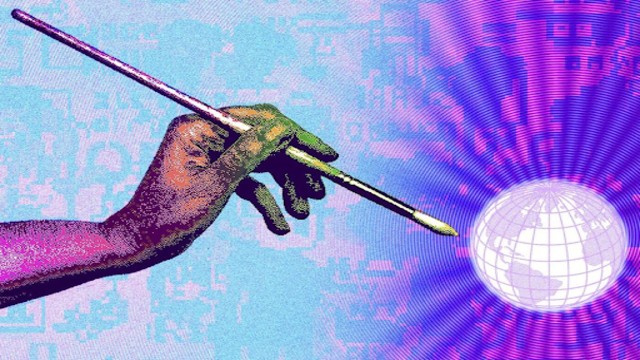
Wplace Turns Chaos Into Global Art on a Shared Canvas. (AP Illustration)
A new corner of the internet is turning creativity into a shared spectacle. Wplace, an online interactive canvas launched on July 21, has already drawn in millions, allowing users worldwide to “paint the world” pixel by pixel.
The sprawling 4-trillion-pixel map is filled with everything, from simple stick figures to elaborate tributes. Near Reykjavík, drawings of Icelandic singer Laufey float over the city. Corpus Christi, Texas, is covered with memorials to the late Tejano star Selena Quintanilla. Soccer crests dominate Buenos Aires, “Squid Game” fan art decorates Seoul, and in New Mexico, Walter White’s monologue from Breaking Bad stretches across the map.
A Digital Rebellion
For many, the appeal lies in its chaotic and unpolished nature. “It’s wild, chaotic, and crude,” said Yotam Ophir, a communications professor at the University at Buffalo. He described Wplace as a refreshing “rebellion” against the polished, algorithm-driven internet.
“It won’t replace Facebook,” he added. “But it’s a reminder that online spaces can still be different.”
That sense of difference has fueled its rapid growth. In just over a month, more than 10.6 million users have joined, co-founder Enzo Watanabe confirmed. It started as a solo project in Brazil, but is now maintained by a team of 46 people and volunteers. Still, he admits the demand has been overwhelming.
Building Art, One Pixel at a Time
The platform works like a game. New users start with a small set of pixels, with more earned every 30 seconds. The more they contribute, the more they unlock — a system that mirrors leveling up in video games.
It takes patience and dedication. Some spend hours sketching designs before committing them to the canvas. Nineteen-year-old Moira Hembns from Edmonton said her Pokémon drawing took three days to complete. “Every art piece takes hours, but I love it,” she said. “I check the map almost every morning now.”
Others feel the same. For 21-year-old Muhammad Aliy Fattah from Malaysia, Wplace has become a creative outlet. “It’s one of the places where I can express myself,” he said, describing how he uses it to honor his favorite video games.
Collaboration has also flourished; in Arizona, one user began drawing houses. Today, that corner of the map has grown into “The Neighborhood,” a collective project of over 50 homes connected by rivers and pathways.
Identity and Protest on Display
Art on Wplace extends far beyond fandoms. It reflects cultural pride, protest, and personal identity. Ophir noted seeing tributes to local musicians, small-town restaurants, and messages of solidarity.
Above Gaza, Palestinian flags and messages of support have appeared. On the Russia-Ukraine border, some use pixels to paint military symbols, while others write calls for peace. Washington, D.C., has filled with political slogans, many referencing Donald Trump.
“There’s a long history of digital spaces as places for protest,” said Carly Kocurek, associate dean at Illinois Tech. “That’s part of Wplace’s pull, even for people not creating protest art.”
Moderation Struggles
With millions participating, moderation has become a growing challenge. The platform bans inappropriate content, hate speech, and vandalism. Many users have argued that rules are inconsistently enforced. While some report repeated harassment, racist imagery, or vandalized pride flags, others say their work is often “grieved” by disruptive players.
A German user, Aaron Hickerson, said, “The number of moderators isn’t enough for the size of the community". In response, Wplace says it is working to improve systems and may adopt new security tools.
Still, not every disruption is unwelcome. A student from Boston laughed after her drawing of the superhero Invincible was altered. “If someone wants to draw over your pixels, they can,” she said.
What Lies Ahead for Wplace
Experts say sustaining such a massive collaborative space will be difficult. “The internet doesn’t have a great record of self-regulation,” said Jessa Lingel, a communications professor at the University of Pennsylvania.
Some users even suggest Wplace might one day need to pause contributions or preserve snapshots, similar to Reddit’s retired r/place experiment. Watanabe said the site will continue welcoming new submissions and may introduce in-platform events.
Whether Wplace lasts years or fades sooner, its impact is undeniable. Millions have already joined in creating a constantly shifting digital tapestry that reflects culture, conflict, humor, and humanity itself.
“It’s just a matter of who notices,” Lingel said. “But for now, Wplace has everyone’s attention.”