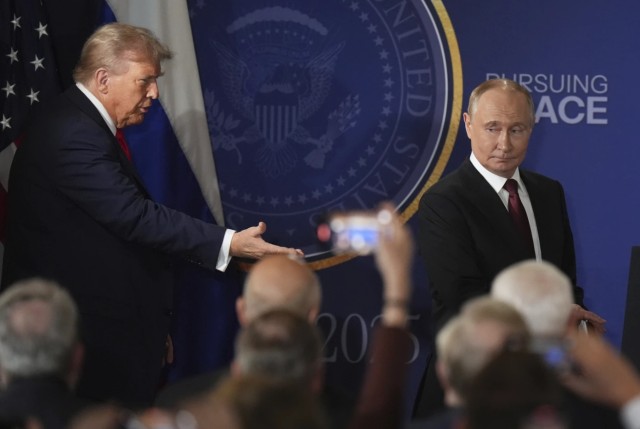
President Donald Trump, left, and Russia’s President Vladimir Putin arrive at a joint press conference at Joint Base Elmendorf- Richardson, Alaska, Friday, Aug, 15 2025.
European leaders are facing one of their toughest dilemmas yet. With the war in Ukraine still raging, the U.K. and France are hosting another high-stakes meeting in Paris to discuss the future of Kyiv’s security. But with no ceasefire in sight and U.S. commitments unclear, Europe finds itself caught in uncertainty.
War in Ukraine Shows No Sign of Ending
Despite months of talks, Ukraine’s war with Russia has no clear end. The coalition of nations supporting Kyiv has been exploring options to deter future Russian aggression. However, the absence of a ceasefire and U.S. hesitation has made concrete plans nearly impossible.
Former military planners warn that Europe cannot finalize security strategies without knowing the role America intends to play. Washington’s ambiguity leaves allies questioning whether commitments will be honored when it matters most.
Trump’s Uncertain Position on Ukraine
U.S. President Donald Trump remains at the center of this debate. Although he has expressed disappointment with Vladimir Putin, his actions tell a different story. At his meeting with Putin in Alaska, Trump failed to secure progress on peace talks.
Days later, in Washington, Trump shifted his stance again. He suggested peace negotiations were preferable to a ceasefire — a position closer to Moscow’s view. This has further weakened Europe’s confidence in U.S. leadership on Ukraine.
Why a Ceasefire Matters for Europe
France’s Emmanuel Macron confirmed that 26 countries, including the U.K. and France, are prepared to form a “reassurance force” for Ukraine. But this would only be possible if a ceasefire is in place. Deploying troops without one is considered far too risky.
Ukrainian President Volodymyr Zelenskyy has signaled openness to dialogue, but Russia refuses to accept him as a legitimate leader. Moscow’s foreign minister Sergey Lavrov has outright dismissed the idea of a peace deal signed by Zelenskyy. This makes any ceasefire agreement highly unlikely in the near term.
The Risks of a European Security Force
Even if a ceasefire is agreed upon, questions remain about what a European force could realistically achieve. Experts argue that such missions would depend heavily on U.S. intelligence and airpower support.
Western countries are unwilling to escalate by directly striking Russian missiles or launch sites. Any response would likely depend on the scale of Western casualties, a scenario that leaders are reluctant to imagine.
Estimates suggest at least 10,000 troops would be needed, potentially 30,000 with rotation included. For the U.K., this could mean committing nearly a third of its deployable army — raising difficult questions about priorities between Ukraine and NATO allies.
Fragile Trust in U.S. Commitments
Another major concern is whether Europe can trust U.S. commitments under Trump. His record of withdrawing from key international agreements, including the Paris climate accord and the Iran nuclear deal, casts doubt on reliability.
Analysts warn that Trump could change his mind on Ukraine at any moment. He may approve U.S. action one day and refuse the next. Such unpredictability leaves European leaders with little assurance.
Europe’s Possible Way Forward
With NATO membership for Ukraine ruled out and U.S. reliability in doubt, Europe may turn to another strategy — arming Kyiv even more heavily. Experts argue that sending advanced weapons and ammunition could be the most practical option for now.
But this approach also comes with challenges. It risks prolonging the war and increasing European dependence on costly defense spending. Leaders know that none of the available options are simple or risk-free.
No Easy Choices for Europe
The Paris meeting underscores a harsh reality: Europe has no clear path forward. Without a U.S.-backed ceasefire and with Russia unwilling to negotiate, security guarantees for Ukraine remain uncertain.
As one expert put it, “There’s no easy way out. None of the options, especially for the Europeans, are good.”