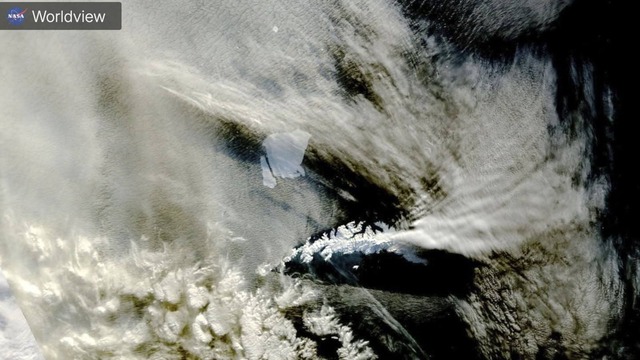
A NASA satellite image taken on Sept. 1, 2025, shows iceberg A23A drifting close to South Georgia Island, off the coast of Antarctica. AP Photo
The world’s largest and longest-lasting iceberg is breaking into smaller pieces. Known as A23A, the megaberg is now losing its title as the biggest block of ice adrift at sea. Scientists warn it may not survive past November.
University of Colorado ice expert Ted Scambos compared its collapse to an avalanche at sea. “It’s an interesting thing to watch, certainly not unprecedented,” he said Thursday. “But every time these happen, it’s sort of a big spectacular event.”
No immediate sea level risk
The breakup of A23A will not directly raise sea levels, since ice shelves already float on the water. But the loss of these shelves creates a bigger problem. Without their support, land glaciers melt faster and slide into the ocean, which does raise sea levels.
A long history at sea
A23A’s story began in 1986, when it broke away from Antarctica’s Filchner–Ronne Ice Shelf. Scientists had tracked a massive crack there since the 1950s, calling it “the Grand Chasm.” For more than 35 years, the iceberg stayed close to Antarctica. But in recent years, it drifted north toward South Georgia Island, the place where large icebergs usually meet their end.
Earlier this year, A23A was the size of Rhode Island and weighed about a trillion tons. Today, it has shrunk to the size of Houston and continues to shrink quickly.
A new largest iceberg
With A23A losing ground, another iceberg has taken the crown. D15A is now the world’s largest iceberg, measuring nearly twice the size of the weakened A23A.
Meanwhile, A23A has splintered into smaller bergs named A23D, A23E, and A23F. Satellite images this week show even more cracks forming.
“It’s still quite thick, but it’s a lot thinner than when it left the continent,” Scambos explained. “Now it’s being flexed by long period waves and tides. That flexing finds weak spots, and those are breaking off.”
Collapse could be sudden
Experts expect the disintegration to speed up. Andrew Meijers of the British Antarctic Survey predicts A23A may fall apart by the end of the Antarctic spring. If it survives until summer, its collapse could be sudden and violent.
Scambos said the berg could even crumble in a single day when warm water reaches its surface. “It will look sort of like an avalanche that’s floating,” he said.
A natural process
Meijers, who visited the iceberg last year, once described it as “a huge wall, a Game of Thrones style wall of ice that towers above the ship.”
Both he and Scambos stress that this process is natural. Massive bergs have broken off Antarctica for centuries. They drift north, weaken in warmer waters, and eventually shatter near South Georgia Island.