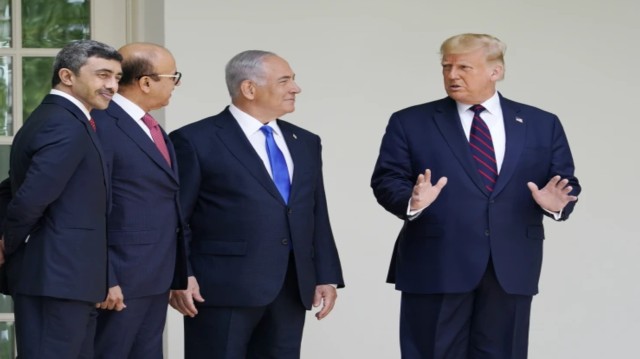
President Donald Trump, far right, walks to the Abraham Accords signing ceremony, from left, United Arab Emirates Foreign Minister Abdullah bin Zayed Al Nahyan, Bahrain Foreign Minister Khalid bin Ahmed Al Khalifa and Israeli Prime Minister Benjamin Netanyahu at the White House on Sept. 15, 2020, in Washington.
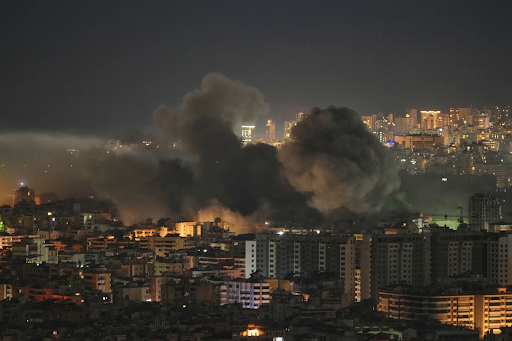
Israel’s airstrike on Qatar has ignited outrage across the Arab world. Leaders in Saudi Arabia, the UAE, and Qatar expressed rare unity in condemning the attack. The strike, which targeted Hamas leaders in Doha, killed several people, including a Qatari security officer.
The fallout now threatens U.S. President Donald Trump’s Middle East priorities, from peace efforts to regional alliances.
Arab Leaders Close Ranks After Israel’s Attack
Just months ago, Trump was welcomed with lavish ceremonies in Gulf palaces. Today, those same rulers are furious at Israel’s actions.
Saudi Crown Prince Mohammed bin Salman called for a united Arab, Islamic, and international response. He described the strike as part of Israel’s “criminal practices.”
UAE President Sheikh Mohammed bin Zayed made a rare visit to Qatar. He embraced Emir Sheikh Tamim bin Hamad Al Thani, a gesture once unthinkable given the past rift between the two nations.
Sheikh Mohammed condemned Israel’s actions, calling them a violation of international laws and norms.
Fears of Abandonment Rise in the Gulf
The strike deepened Gulf nations’ biggest fear: that Washington may no longer shield them from regional threats. For decades, U.S. protection was seen as a guarantee against aggressors like Saddam Hussein. Now, Israel under Prime Minister Benjamin Netanyahu seems to be testing those boundaries.
Trump distanced himself from the airstrike, insisting it did not serve U.S. or Israeli goals. He reassured Qatar it would not be repeated. Yet his unwavering support for Israel, even as it disregards global norms, unsettles Gulf capitals.
Qatar Denounces Israel’s “State Terror”
Qatar’s Prime Minister Sheikh Mohammed bin Abdulrahman Al Thani branded the strike an act of “state terror.” He accused Netanyahu of barbarism and questioned the validity of ongoing mediation talks.
The attack occurred as Hamas officials were reviewing a U.S. ceasefire plan. At least five Hamas members died, along with a Qatari officer.
Netanyahu warned that Israel would strike again if Qatar continued hosting Hamas leaders. His blunt threat drew sharp criticism from the UAE. The Gulf Cooperation Council declared any attack on a member state as an assault on collective Gulf security.
Tensions Jeopardize Abraham Accords
The UAE was central to the 2020 Abraham Accords, which normalized ties between Israel and several Arab nations. The agreements were hailed as Trump’s biggest foreign policy success.
But Israel’s assault on Qatar casts doubt on the durability of those deals. The UAE has already warned Israel that annexation of the West Bank would be a “red line.”
Netanyahu’s far-right allies, however, continue to push for settlement expansion. This strains the very agreements meant to stabilize relations.
Saudi Arabia Hardens Its Stance
Hopes for Israeli-Saudi normalization appear increasingly remote. Riyadh insists recognition will only come if Palestinians gain statehood in Gaza, the West Bank, and East Jerusalem.
Israel rejects such demands, arguing they would reward Hamas. Crown Prince Mohammed bin Salman has meanwhile accused Israel of genocide and drawn closer to Iran, once viewed as Saudi Arabia’s top rival.
U.S. Commitments Under Pressure
Since the 1991 Gulf War, Gulf monarchies relied on U.S. bases for protection in exchange for energy stability. That trust is wavering.
Iran’s June attack on a U.S. base in Qatar raised alarm. But Israel’s direct strike on Doha is seen as an even greater violation of trust.
For Trump, the challenge is clear. His push to end the Gaza war, expand the Abraham Accords, and counter Chinese and Russian influence may now falter. Netanyahu’s actions risk undoing years of U.S. diplomacy in the region.
The anger brewing in Riyadh, Abu Dhabi, and Doha shows how fragile Middle East alliances remain when Israel strikes beyond its borders.