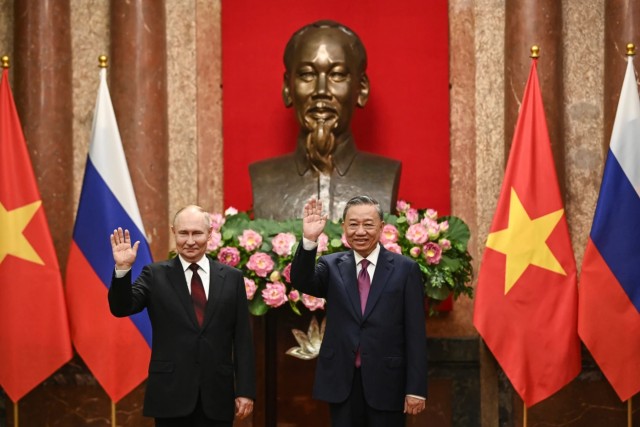
Russian President Vladimir Putin, left, and Vietnam's president Lam Pose for photos at the Presidential palace in Hanoi, Vietnam on June 10, 2024.
Russia and Vietnam have built a secretive financial pathway to bypass Western sanctions. According to internal Vietnamese documents obtained by the Associated Press, both nations are channeling profits from joint oil and gas ventures to settle defense contracts. This backdoor method avoids international banking systems and shields them from American sanctions.
The arrangement allows Hanoi to repay Moscow for military equipment, including fighter jets and tanks, without direct cash transfers. The timing is sensitive as Washington pushes for closer ties with Vietnam to counter China’s influence in Southeast Asia.
A Hidden Payment System
The documents reveal that Vietnam buys Russian arms on credit and repays the debt using profits from Rusvietpetro, a joint oil venture in Siberia. Instead of routing money through global networks like SWIFT, the transactions are contained within Vietnam and Russia.
This ensures payments remain confidential, even as the U.S. and its allies expand sanctions against Moscow over its war in Ukraine. Analysts describe the method as more advanced than typical offset or counter-trade deals.
Why This Matters Now
The U.S. has increased tariffs on Vietnamese goods and warned of penalties if Hanoi continues purchasing Russian weapons. At the same time, Washington sees Vietnam as a strategic partner against Chinese expansion in the South China Sea.
The European Union and Britain have also imposed new sanctions targeting Russia’s oil revenues and military supplies. Yet, Vietnam continues to deepen energy and defense ties with Moscow, complicating its balancing act between East and West.
How the Mechanism Operates
A 2024 memo outlines the system in detail:
- Profits from Rusvietpetro are used to repay loans for Russian arms purchases.
- Excess profits are transferred to Russian oil giant Zarubezhneft.
- Zarubezhneft’s joint venture in Vietnam then transfers equivalent funds to Petrovietnam (PVN).
This cycle avoids cross-border transactions and minimizes exposure to Western sanctions. “The method is considered confidential and appropriate,” PVN’s director wrote in the document.
Russia’s Flexible Approach
Experts note that Russia has long offered creative payment mechanisms for arms sales. In 2017, Moscow supplied fighter jets to Indonesia in exchange for commodities like palm oil and coffee. Vietnam’s scheme, however, takes flexibility to a new level, relying on energy profits rather than goods.
Western diplomats in Hanoi said they suspected such arrangements existed but had never seen the specifics until now.
Risks of Secondary Sanctions
While Zarubezhneft itself is not yet sanctioned, several of its top executives are. U.S. laws like the Countering America’s Adversaries Through Sanctions Act (CAATSA) allow penalties on countries dealing with Russia’s defense sector.
Experts warn that Vietnam could face secondary sanctions. The uncertainty around enforcement often pushes governments and companies to overcomply, cutting off risky partnerships entirely.
Vietnam’s Strategic Calculations
Vietnam has one of Southeast Asia’s strongest militaries, heavily dependent on Russian equipment. Recent contracts worth billions highlight Hanoi’s reliance on Moscow for spare parts and upgrades.
Yet, Vietnam also counts the U.S. as its largest export market and a key defense partner. Washington lifted its arms embargo in 2016, and both sides now share a Comprehensive Strategic Partnership.
Caught between economic opportunity and military dependency, Vietnam must carefully balance its ties with Moscow and Washington.
Documents Confirm the Arrangement
The authenticity of the leaked documents has been verified by independent analysts. They show that the mechanism was finalized before Russian President Vladimir Putin’s 2024 visit to Hanoi. During that trip, Russia secured new licenses for energy exploration in Vietnamese waters.
Follow-up deals signed in Moscow this year reaffirm long-term cooperation in oil, gas, and defense. These agreements suggest Vietnam has no immediate plans to reduce reliance on Russian support.
What Lies Ahead
As U.S. and EU sanctions intensify, Vietnam’s secretive payment scheme could face mounting pressure. Analysts warn that Washington’s current administration is more transactional and less forgiving than past ones.
Hanoi’s challenge will be to maintain its defense partnership with Russia without jeopardizing its crucial economic and diplomatic ties with the West.