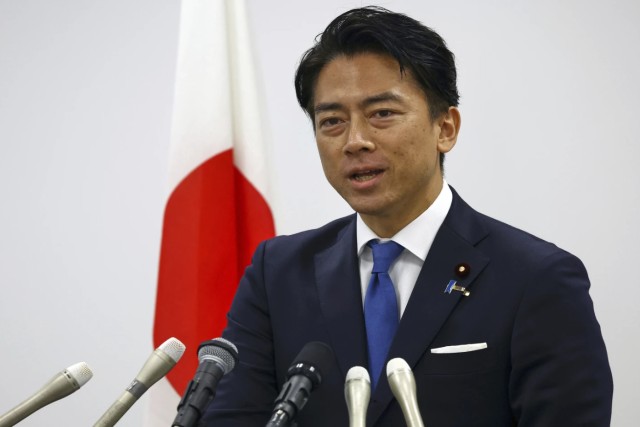
Japan’s agriculture minister shinjiro koizumi, who is the son of the former prime minister Junichiro koizumi, attends a press conference about his running in the ruling Liberal Democratic party leadership race in Tokyo, sunday, sept 20, 2025.
Japan’s ruling Liberal Democratic Party (LDP) has officially kicked off its leadership race to find a successor to outgoing Prime Minister Shigeru Ishiba. With the slogan “Change, LDP,” the election marks a pivotal moment for Japan’s political future.
The vote will take place on October 4, and five prominent candidates are in the running. The winner will inherit the challenge of reviving the party’s reputation after its recent electoral setbacks and addressing rising public discontent over soaring prices.
Why the LDP Leadership Election Matters
The LDP remains Japan’s largest political party, even after losing ground in both houses of parliament. The next leader will likely become prime minister because opposition parties remain divided and too weak to form a unified coalition.
However, success will require cooperation. Without building alliances with opposition lawmakers, the new LDP leader risks frequent no-confidence votes and another cycle of short-lived leadership.
Who Votes in the LDP Election?
This vote is not open to the general public. Instead, it will be decided by:
- 295 LDP parliamentarians
- Around 1 million dues-paying party members
That is less than 1% of Japan’s total eligible voters.
A majority winner in the first round becomes the party leader. If no candidate secures a majority, the top two contenders face a runoff.
The Five Candidates for LDP Leadership
All five contenders are current or former Cabinet ministers. Each brands themselves as a moderate conservative, emphasizing cooperation with opposition groups. Here’s a closer look at the candidates:
Shinjiro Koizumi, 44
The son of former Prime Minister Junichiro Koizumi, he is making his second leadership bid. As agriculture minister, he acted decisively to release rice reserves, lowering food prices. Koizumi promises to rebuild trust, tackle inflation, and respond to public concerns. If elected, he would be Japan’s youngest prime minister since 1885.
Sanae Takaichi, 64
A close ally of late Prime Minister Shinzo Abe, she is known for her hardline conservative stance. Takaichi supports higher defense spending, economic growth through public investment, and traditional family values. If successful, she would become Japan’s first female prime minister—a historic shift in a nation ranked low in gender equality.
Yoshimasa Hayashi, 64
Currently chief cabinet secretary, Hayashi has served as foreign, defense, and education minister. Harvard-educated and fluent in English, he emphasizes wage growth, economic stability, and strong defense. Known for his approachable style, he also plays music in a parliamentary pop band.
Toshimitsu Motegi, 69
A seasoned diplomat and trade negotiator, Motegi has represented Japan in major global talks, including during Donald Trump’s presidency. He stresses the importance of the Japan-U.S. alliance and promises to strengthen security ties.
Takayuki Kobayashi, 50
Nicknamed “Koba-Hawk,” Kobayashi is an ultra-conservative who prioritizes defense and economic security. He calls for stricter immigration rules and higher defense spending, beyond the current 2% of GDP target.
A Possible First Female Prime Minister
Takaichi’s candidacy is significant. If elected, she would break a historic barrier in Japanese politics. However, her revisionist views on wartime history and opposition to progressive reforms have sparked concerns at home and abroad. Critics warn her leadership could strain relations with China and South Korea.
Still, Takaichi has softened her rhetoric in recent speeches, stressing cooperation with China on economic issues while avoiding direct answers about her controversial visits to Yasukuni Shrine.
Opposition Cooperation Will Shape Stability
Experts agree that cooperation with opposition parties is crucial for Japan’s stability, especially amid global security challenges. The next prime minister must also prepare for growing U.S. demands for greater defense contributions under Donald Trump.
Several candidates have already reached out to opposition parties like Ishin and the Democratic Party for the People. Koizumi met Osaka’s governor, while Hayashi dined with Ishin lawmakers. Motegi has publicly supported forming coalitions.
What’s Next for Japan?
As the October 4 LDP leadership vote approaches, the stakes are high. The winner must act quickly to restore public trust, stabilize the economy, and secure political partnerships.
Whether it’s Koizumi’s youthful reformist vision, Takaichi’s historic bid, or the seasoned experience of Hayashi, Motegi, or Kobayashi, Japan’s next leader will shape the nation’s direction in a turbulent global landscape.