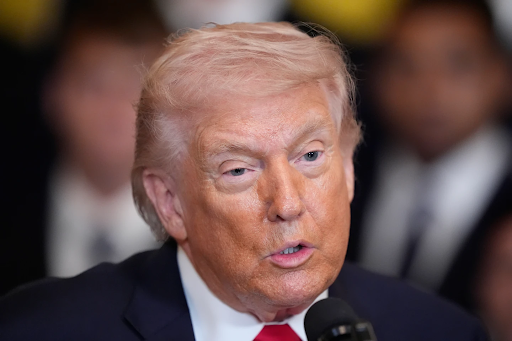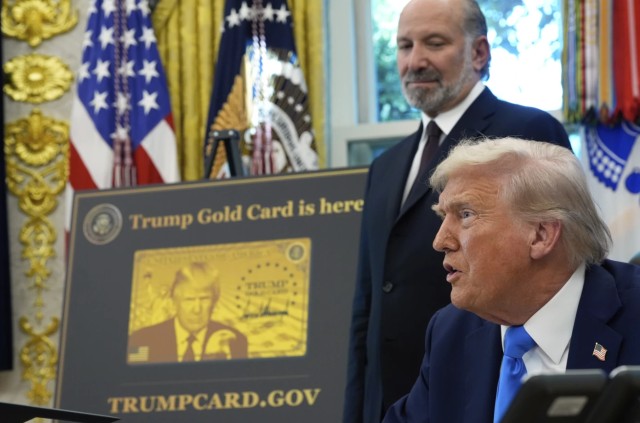
President Donald Trump speaks alongside a poster of trump gold card in the oval office of the white house, Friday, sept 19, 2025.
The Trump administration’s sudden move to impose a $100,000 H-1B visa fee has left employers, students, and workers stunned. The decision, which took effect just 24 hours after its announcement, has sparked widespread confusion and fear among U.S. businesses and foreign talent, especially in India.
While the White House has clarified that the new fee does not apply to existing visa holders, uncertainty continues to loom. Many companies are now advising their foreign employees not to travel abroad until the process becomes clearer.
What is an H-1B Visa?
The H-1B visa was created under the 1990 Immigration Act to allow U.S. companies to hire skilled foreign workers. It is a non-immigrant visa designed for specialized roles that often cannot be filled by American workers.
An H-1B is valid for three years and can be extended for another three. Currently, there are around 700,000 H-1B holders in the U.S., with another half a million dependents.
The visas are highly competitive, capped at 65,000 annually, with an extra 20,000 reserved for candidates holding advanced degrees. Universities and nonprofit research organizations are exempt from these caps.
According to Pew Research Center, nearly 75% of approved H-1B applications in 2023 came from India, highlighting the country’s dependence on the program.
Trump’s $100,000 H-1B Fee
The application process for an H-1B visa previously cost just $215 plus additional processing charges. On Friday, the Trump administration announced a dramatic jump—a $100,000 fee per visa, effective immediately.
Initially, officials suggested the fee might apply annually, adding up to $600,000 over six years. However, the White House later clarified it would be a one-time payment.
The administration also introduced a $1 million “gold card” visa for wealthy individuals, further signaling its shift in immigration strategy.
Why Target the H-1B Visa?
The White House argues that the H-1B program undercuts American workers by allowing companies to replace them with lower-paid foreign staff. Outsourcing firms like Tata Consultancy Services often supply Indian workers to major corporations, fueling criticism.
In 2020, the Economic Policy Institute reported that 60% of H-1B positions were certified at wages below the median. Critics argue this incentivizes companies to cut U.S. jobs and hire foreign talent at lower costs.
Still, many economists say abuses are rare. Giovanni Peri, director at UC Davis’ Global Migration Center, noted that most H-1B professionals are genuinely skilled workers who boost innovation and productivity.
Impact on Businesses and Workers
Large tech companies may absorb the steep fee, but small businesses and startups are expected to struggle. Greg Morrisett of Cornell Tech warned that many young companies will be forced to move operations abroad, draining U.S. innovation.
Sectors such as healthcare, retail, and hospitality—which accounted for 25% of H-1B visas last year—may also be hit hard, as the new cost could exceed their budgets.
For individual workers, the uncertainty is overwhelming. Alan Wu, a data scientist in Indiana, said he was shocked by the abrupt policy. After years of studying in the U.S. and twice failing the visa lottery, he fears his dream of building a life in America may end.
Indian consultancy firms expect migration trends to shift. Navneet Singh of Go Global Immigration believes countries like Germany, France, and Canada will benefit as skilled workers look for alternatives.
The Road Ahead
Legal challenges are expected, as many argue Trump has sidestepped Congress in reshaping the immigration system. The policy may also increase labor costs in the U.S., raising wages but shrinking the skilled workforce.
For now, confusion persists. Employers are left wondering how to pay the new fee, while thousands of foreign workers face disrupted plans. For students in India dreaming of U.S. opportunities, the new H-1B visa fee feels like a closed door.
As Morrisett warned, if startups and talent continue to move overseas, the U.S. risks losing its edge in the next generation of global tech leadership.