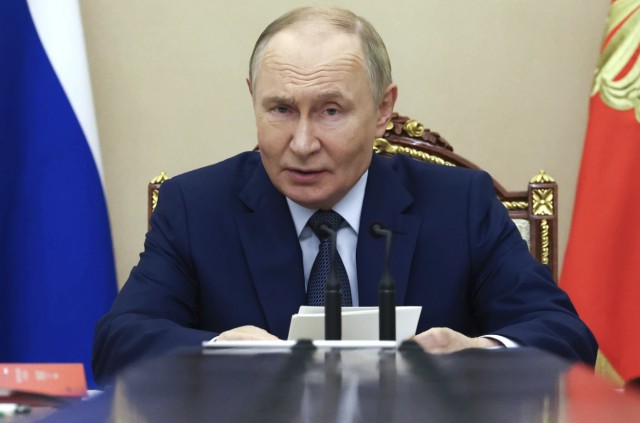
Russian President Vladimir Putin chairs a security council meeting at the Kremlin in Moscow, Russia, Monday, September 22, 2025.
Russian President Vladimir Putin on Monday declared that Russia is ready to continue following the limits set by the last remaining nuclear arms pact with the United States for one year after it officially expires. The New START treaty, signed in 2010, is set to end in February 2026, and Putin urged Washington to reciprocate.
He warned that letting the agreement lapse could destabilize global security and encourage nuclear proliferation. His remarks were delivered amid rising tensions between Russia and Western nations, and growing concerns that the conflict in Ukraine could spill beyond its borders.
“To prevent a further strategic arms race and to maintain predictability, it is justified to preserve the status quo established by the New START Treaty,” Putin said during a televised address from the Kremlin. He stressed that Russia is prepared to uphold the treaty’s limits for an additional year after February 5, 2026.
Arms Control Advocates Welcome the Move
Experts on arms control have long expressed concern about the treaty’s looming expiration and the absence of a replacement deal. They have warned that the lack of limits could trigger a new nuclear arms race and increase the risk of a global nuclear conflict.
Putin highlighted that maintaining these limits could also help create a “conducive atmosphere for strategic dialogue with the U.S.” He reinforced that preserving nuclear constraints is a step toward stability in global security.
The New START treaty, initially signed by U.S. President Barack Obama and Russian President Dmitry Medvedev, caps each country at 1,550 deployed nuclear warheads and 700 deployed missiles and bombers. It also requires on-site inspections to ensure compliance, although inspections were paused in 2020 due to the COVID-19 pandemic and have not resumed. The pact was originally set to expire in 2021 but was extended for five years.
Putin Calls for U.S. Reciprocity
Putin made it clear that Russia expects the United States to follow its lead and respect the treaty’s limits. “This measure will only be viable if the United States acts in a similar manner,” he stated.
Daryl G. Kimball, director of the Washington-based Arms Control Association, called Putin’s statement “an important and positive move.” Experts have urged both nations to reach a temporary agreement to maintain nuclear limits.
Kimball explained that sticking to existing nuclear caps could reduce tensions, prevent an expensive arms race, and provide leverage to manage China’s growing arsenal. It would also allow time for negotiations on a more comprehensive treaty.
Monitoring and Strategic Concerns
In his address, Putin instructed Russian agencies to closely track U.S. activities, particularly regarding strategic offensive arms. He mentioned concerns over any potential deployment of missile interceptors in space, noting that Russia would “respond accordingly” to such moves.
A Fragile Nuclear Pact
In February 2023, Putin suspended Russia’s participation in the New START treaty, citing security concerns. He argued that Moscow could not allow U.S. inspections while Washington and NATO allies openly declared Moscow’s defeat in Ukraine as a goal. Despite this, Russia has pledged to respect nuclear caps and notify the U.S. about ballistic missile tests.
The New START is currently the only major U.S.-Russian nuclear arms pact in effect. Another key agreement, the 1987 Intermediate-Range Nuclear Forces Treaty, was terminated in 2019. That pact banned land-based missiles with ranges between 500 and 5,500 kilometers.
Rising Tensions with the West
Tensions between Russia and NATO countries have increased in recent months. European allies have accused Russia of provocations, including drone flights in Polish airspace and fighter jets entering Estonian airspace.
Experts warn that the expiration of the New START treaty without an interim agreement could escalate global nuclear risks. Putin’s call for maintaining limits highlights the delicate balance required to prevent a new arms race.