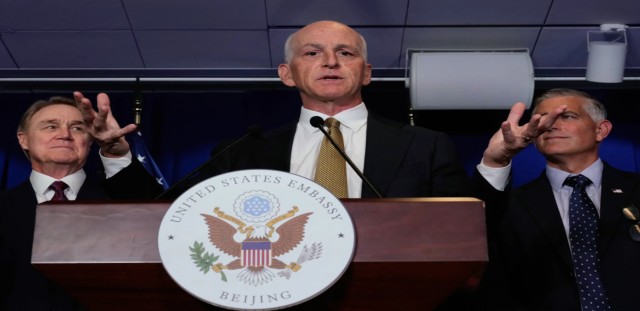
US. Rep, Adam Smith, center, speaks during a conference at a US Embassy in Beijing, China.
The United States and China remain divided on major global issues, according to a senior U.S. lawmaker leading a rare congressional visit to Beijing. Representative Adam Smith, a Democrat on the House Armed Services Committee, said Tuesday that the two nations are “talking past each other” rather than moving toward solutions.
This visit is the first by a U.S. House delegation to China since 2019. It comes at a time when relations between the US and China are tense, with disputes over trade, technology, and global security shaping their dialogue.
A Mission to Restart Dialogue
Smith emphasized that the main goal of the trip was to foster better communication. He explained that meaningful engagement has not yet begun.
“You have to start by saying, ‘Here’s my perspective, what’s yours?’ We’re not there yet. Right now, we’re just talking past each other,” Smith told reporters.
The bipartisan delegation hopes to push for more consistent dialogue and build a foundation to reduce misunderstandings that risk escalation.
Key Concerns on Security and Trade
The delegation raised two major concerns: the inflow of fentanyl into the U.S. and China’s restrictions on rare earth exports. Lawmakers urged China to take stronger action on both fronts, highlighting their global impact.
Smith also pointed to rising risks between the U.S. and Chinese militaries. He said their ships and planes have been operating dangerously close to each other in contested areas like the South China Sea.
“At the height of the Cold War, the U.S. and the Soviet Union maintained regular talks and treaties,” Smith said. “We need that same stability with China.”
In October 2023, tensions spiked when a Chinese fighter jet flew within 10 feet of an American bomber over the South China Sea.
Calls for Greater Engagement
Despite these frictions, Smith insisted on the need for more engagement with Beijing. He argued that many seemingly impossible disputes could be resolved if both sides approached discussions with a cooperative mindset.
Later on Tuesday, Smith met with Chinese Foreign Minister Wang Yi. Their talks struck a more positive note. Wang said China’s “door was always open” to dialogue.
Smith stressed that the US and China could work together on poverty reduction and public health challenges. “The capabilities of both countries are unmatched,” he said. “If we join forces, the possibilities are endless.”
Meetings with Top Chinese Leaders
Since arriving Sunday, the delegation has met with several senior Chinese officials, including Premier Li Qiang, Defense Minister Dong Jun, Vice Premier He Lifeng, and National People’s Congress Chairman Zhao Leji.
The meetings aimed to rebuild trust after years of limited communication. The US and Chinese militaries suspended contact in August 2022 following then-House Speaker Nancy Pelosi’s controversial visit to Taiwan. Beijing strongly opposed that trip, as it views Taiwan as part of its territory.
Dialogue was only restored in November 2023 after a rare meeting between Chinese President Xi Jinping and U.S. President Joe Biden. However, the frequency and depth of those military exchanges remain uncertain. Smith declined to clarify how often communication has occurred since then.
Broader Political Context
The congressional delegation includes Michael Baumgartner, a Republican member of the House Foreign Affairs Committee, along with Democrats Ro Khanna and Chrissy Houlahan. The group is scheduled to remain in China until Thursday.
Meanwhile, U.S. politics continue to influence the relationship. Former President Donald Trump announced plans to meet Xi Jinping at a regional summit in South Korea in October, followed by a visit to China early next year. His statement came after a lengthy phone call with Xi on Friday.
Outlook for US and China Relations
The visit signals a cautious attempt to rebuild channels between the US and China after years of mistrust. While progress remains slow, both sides appear open to further dialogue.
Smith summed up the purpose of the trip with cautious optimism. “When you start talking from a standpoint of solving problems, remarkable things can happen,” he said.
For now, the challenge lies in moving beyond “talking past each other” and toward meaningful cooperation that addresses security, trade, and global challenges affecting both nations.