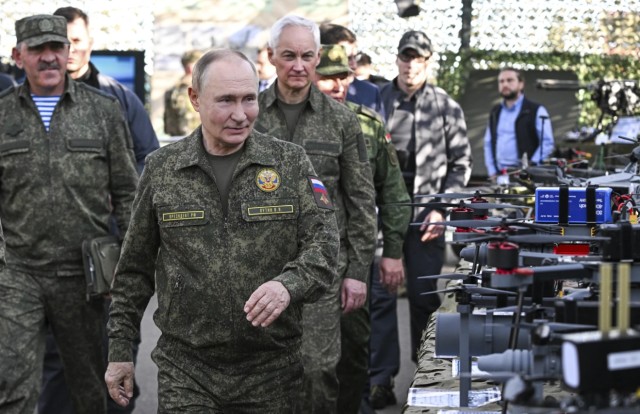
Russian President Vladimir Putin accompanied by Deputy Defence Minister Yunus-Bek Yevurov, left, and Defence Minister Andrei Bedousov, right, inspects Russian weapons and equipment during his visit to the Russian-Belgarusian joint military drills “Zepad 2025”.
Unprecedented Russian forays into NATO airspace this month have triggered alarm across Europe. The incidents raise serious questions about Moscow’s intentions—whether it is testing the alliance’s defense capabilities, signaling political pressure, or diverting NATO resources away from Ukraine.
Russian aircraft and drones have been violating NATO borders for decades, often denied or dismissed as accidents. But since the 2022 invasion of Ukraine, such actions carry higher stakes. The recent swarm of drones over Poland and fighter jet incursions into Estonia signal a shift from past patterns.
A Surge in NATO Airspace Violations
The most alarming incident occurred on September 10, when about 20 Russian drones entered Poland’s NATO airspace. Some were downed by NATO jets, while others crashed. This marked the first direct military clash between the alliance and Russia since the Ukraine invasion.
Russia denied targeting Poland. Belarus, Moscow’s ally, argued that the drones’ signals were jammed by Ukraine. European leaders, however, see these events as deliberate provocations. Estonia’s foreign minister described the 12-minute incursion by Russian fighter jets as “brazen.” Romania and Latvia also reported drones entering their airspace earlier this month.
Why Is Russia Testing NATO Airspace?
Experts believe these violations are part of Moscow’s larger strategy. Before invading Ukraine, Russia demanded NATO halt expansion and reduce troop presence near its borders. Those demands were rejected.
Now, with battlefield progress in Ukraine and leverage in peace talks, Russia may be escalating pressure. President Vladimir Putin has repeatedly warned NATO against allowing Ukraine to strike deep into Russian territory with Western weapons. He has also threatened retaliation against NATO facilities supporting such attacks.
Analysts suggest Russia may be using airspace incursions to measure NATO’s unity. By provoking responses, Moscow could identify weak spots or indecision within the alliance. Some believe the goal is to force NATO to shift resources from Ukraine’s defense to bolstering its own borders.
Signals and Strategy
Estonian Defense Minister Hanno Pevkur argued that Russia wants to weaken NATO’s support for Ukraine. “Russia is trying to tear us out from Ukraine,” he said, noting that resources spent on defending Estonia could reduce aid to Kyiv.
Mark Galeotti, a Russian politics expert, views the incursions as “coercive signaling.” Moscow, he argues, wants NATO to see how dangerous the situation already is and avoid deeper involvement in Ukraine.
Other analysts suggest Russia is planting doubt within the alliance. Edward Lucas of the Center for European Policy Analysis noted that if NATO members question whether allies will defend them, unity weakens. “Russia does not need to defeat NATO militarily if it can defeat it politically,” he wrote.
NATO’s Response and the U.S. Role
Following the drone incident, Poland invoked a NATO mechanism that allows urgent consultations when territorial integrity is threatened. NATO then launched an operation to strengthen its eastern air defenses.
Prime Minister Donald Tusk warned that Poland would “without discussion” shoot down any object violating its territory. NATO Secretary-General Mark Rutte, however, stressed that responses would depend on intelligence regarding threats.
The United States, NATO’s largest member, has sent mixed signals. President Donald Trump initially suggested the Polish incursion “could have been a mistake.” Later, he endorsed shooting down intruding Russian aircraft but avoided promising direct U.S. involvement in such confrontations.
What Lies Ahead
The uptick in NATO airspace incursions highlights the dangerous balancing act between Moscow and the alliance. Each violation increases the risk of escalation. While NATO pledges to defend its members, internal debates over how far to go could test its unity.
For Russia, these provocations may serve both as a warning and as leverage. By keeping NATO guessing, Moscow seeks to unsettle its adversaries while strengthening its hand in Ukraine and beyond.
The coming months may reveal whether these incidents remain isolated provocations or the beginning of a broader confrontation. For now, Europe watches nervously as Russian aircraft and drones continue to test NATO’s resolve.